| 1 |
 |
“...DANIEL DE LEON
THE MAN AND HIS WORK
A SYMPOSIUM
ILLUSTRATED
4:,/V
National Executive Committee
Socialist Labor Party
45 Roe Si., Ntw York
1920...”
|
|
| 2 |
 |
“...Copyright, 1919, by the
National Executive Committee
Socialist Labor Party of America....”
|
|
| 3 |
 |
“...REMINISCENCES
DANIEL DE LEON
LEADER TEACHER PATHFINDER
HENRY KUHN
Ferncr Nttiooa) Secretary, Socialist Labor Party of Aserica...”
|
|
| 4 |
 |
“...INTRODUCTORY
When, on Saturday, September 14, 1918, our National Sec-
retary, Arnold Petersen, urged upon me that I undertake to
add to the present volume such of my reminiscences durin*
the period of my close association with our late comrade,
Daniel De Leon, as I considered of value as a contribution to
the history of the Socialist Labor Party, I was at first taken
aback. I knew what that meant in point of research, in gather-
ing again the mass of material that had passed through my
hands during the formative and most stressful period of the
Partys existence and I also felt that, not being able to give to
so important an undertaking a measure of time ample enough
to insure painstaking performance, I would have to rely, ex-
tensively, upon the indulgence of the reader, the more so since
I can not, by any stretch of the imagination, be considered an
historian, either by others or by myself.
However, the idea once implanted did not let me rest, but
continued to...”
|
|
| 5 |
 |
“...r,-
, IB- 1
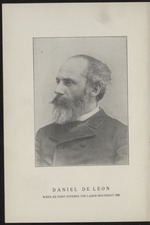
DANIEL DELEON
WHEN HE FIRST ENTERED THE LABOR MOVEMENT 1886...”
|
|
| 6 |
 |
“...4 REMINISCENCES OF DANIEL DE LEON.
know him better, a few years later, he had emancipated him-
self in that respect and he remained in that state ever after,
while the rest of us continued the slaves of convention in the
matter of wearing collars.
In 1889, the seat of the National Executive Committee of
the Socialist Labor Party having been transferred from New
York to Brooklyn by the national convention held in Chicago
that year, the Partys agitation was, naturally, directed from
that point. The then National Secretary was Benjamin J.
Gretsch, a young Russian law student, and I remember well
the day when Gretsch, at one of the meetings of the body,
proposed that we arrange an agitation tour with De Leon as
the speaker. This tour, undertaken in 1891, and extending as
far west as the Pacific coast, brought De Leon over to our
meetings, first before he started and again when he had re-
turned, and we bad, besides, his frequent and comprehensive
reports while en route...”
|
|
| 7 |
 |
“... running battle with scarcely
a breathing spell between different actions. I took office in
September, 1891, and, from that time on, came into ever closer
personal contact with De Leon, learning to know him per-
haps as intimately as one man may know another. I was then
just beyond 32 and De Leon was 7 years my senior. He a man
of broad education, of much experience in life, of great in-
tellectual force, whose active and comprehensive mind rapidly
digested the new experience he was gaining through his con-
nection with the Labor movement and, who, thereupon, force-
fully reacted upon his environment. I, on the other hand, a
proletarian, taken from the workshop and put into an office,
still plastic, eager to learn, with some practical experience in
the Labor movement, both in its economic and in its political
phases, having gone through the Knights of Labor during the
palmiest days of that order as a member of the Bookbinders
Union and having been, for several years past, a...”
|
|
| 8 |
 |
“...REMINISCENCES OF DANIEL DE LEON.
De Leon Instrument of Providence
Naturally, the influence upon me by a mind like De Leons
-ras great and did much to shape the entire course of my life,
tfee more so since that influence was constant for over 20
years of close co-operation through the storm and stress, the
endless difficulties and the incessant struggles of the Socialist
movement of America. Indeed, no sentient human being
could have escaped being influenced by a per,sonality such as
De Leons. Elis vast knowledge, made mobile and available
hy a virile mentality, the purity of his motives engendering a
flawless devotion to the movement, his absolute fearlessness
*tid steadfastness in the face of whatever might befall, never
-wavering, never faltering, never perturbed, no matter what
disappointments, setbacks and difficulties the troubled waters
of the Labor movement might cast ashore, he was, indeed, a
tower of strength. It was as though Providence had first
shaped and...”
|
|
| 9 |
 |
“...REMINISCENCES OF DANIEL DE LEON. 7
made to inocculate the trade unions of the land with Socialist
revolutionary principles by means of a method designated in
those days as **boring from within.* These efforts were made
in the local unions, in the local central bodies and, through
these, it was sought to carry the revolutionary propaganda
into the national conventions of the American Federation o!
Labor, as well as of the Knights of Labor. In regard to the
former organization, these efforts culminated, in the early
90s, in the election of Lucien Sanial as the delegate of the
New York Central Labor Federation to the annual national
convention of the American Federation of Labor, at Detroit,
Mich. It must here be borne in mind that Section New York,
S. L. P., was represented in the C. L. F.; that Sanial was the
Sections delegate to that body; that the C. L. F. chose him
as its delegate to the Detroit convention of the A. F. of L.,
with the openly understood and expressed...”
|
|
| 10 |
 |
“... influences, scenting the rising dan-
ger, had provided the antidote by the formation of the Amer-
ican Federation of Labor, in 1881, and the incessant fight it
had carried on against the Order had told. But that alone
would not have mattered so much had not these same capital-
ist influences carried the corroding poison of corruption into
the Order. Its management had slipped out of the hands of
the element that had founded it and a set of crooked politi-
cians, headed by one Terence V. Powderly, as General Mas-
ter Workman, was at the helm. Thus, when De Leon entered
the order, via D. A. 49, the organization had long ago passed
its zenith and was on the downward part of the curve. But
it still had respectable numbers and, with all the vim of his
energetic personality, De Leon set to work to clean out that
nest of fakers. He beat Powderly and made him quit, only to
see him rewarded with a political job by the capitalist clas.s
he had served so well. He beat Powderlys successor...”
|
|
| 11 |
 |
“...REMINISCENCES OF DANIEL DE LEON. 9
cialist movement of America, the formation of the Socialist
Trade and Labor Alliance.
Right here, it is necessary to note, for the sake of his-
toric accuracy, that in all this prodigious work, from its very
beginning back in 1889, down to the year 1902, De Leon had
been ably and chiefly assisted by two men; Hugo Vogt, a for-
mer student of jurisprudence, whom the Bismarckian anti-
Socialist laws had exiled from Germany; and Lucicn Sanial,
in his younger days a French naval officer, who had long been
active in the Socialist movement, first in France and, later,
for many years in America. Sanial was De Leons senior by
about 18 to 20 years, while Vogt was about 7 years younger
than De Leon. Of the two, Vogt was perhaps the more able
and certainly the more efficient, partly because of mental at-
tributes and also because, being himself a German, he was in
a position, up to 1899, to wield considerable influence within
and upon the many...”
|
|
| 12 |
 |
“...10 REMINISCENCES OF DANIEL DE LEON.
imposes upon men who have to stand in the breach, so to
speak. These two of the tri-partite team succumbed; the
third, De Leon, like a rock jutting out into a raging sea,
breasted the dash of the angry waves until the grim reaper,
death, laid low the mortal part of him; his other part, that
which in the language of Sam French can not, will trot and
did not die, is immortal and will be with us as a living force
as long as the struggle for human emancipation will go on, is
influencing our thought and action today and will continue to
influence countless other human beings yet unborn.
Factors Three
Returning from this digression to the subject in hand, and
taking up again the thread of the narrative when the Socialist
Trade and Labor Alliance was about to be formed, several fac-
tors must now be borne in mind. One is that the backbone of
the new organization was D. A. 49, K. of L. This District
Assembly pulled away from the rapidly...”
|
|
| 13 |
 |
“... them a fourth, the
New Yorker Volkszeitung, a daily newspaper professedly
Socialist, and serving as the bond that connected the factors
two and three. For the sake of historic accuracy it must Ie
noted that there were three other bodies that joined the nev*-
organization, a small central body in Brooklyn, called the
Socialist Labor Federation, a sort of offshoot of the Neer...”
|
|
| 14 |
 |
“..., organizing, both in the trade
unions and in the Party, both locally and elsewhere, aside
from Lis work as editor in chief of The People, the official
Party Organ, his efforts ably seconded by the two men al-
ready mentioned, Sanial and Vogt.
Labor Faker An Indigenous Product
At this juncture, it is well again to digress a little and
throw a backward glance at what the Party organization had
been doing and how it had been faring in the meantime. This
was .ray specific field and to it I had devoted almost my en-
tire attention, taking a hand only now and then in the work
on the economic field. The Party organization had developed
wonderfully, the number of local Sections having increased
from 113, in 1893, to 200 in 1896, with a membership increase
that sent us close up to the 6,000 mark. The Partys vote
showed marked increases where we had been in the field be-
fore, and newly-formed Sections, in many parts of the coun-
try, had raised the political standard and had added to the...”
|
|
| 15 |
 |
“...REMINISCENCES OF DANIEL DE LEON.
lion. The People had become a paper admired, respected
and feared by such as had reasons to fear it. De Leon knew
the American labor faker to be one of the most serious ob-
stacles in the path of the revolutionary Socialist movement
and he dealt with him accordingly, camping on his trail, ex-
posing his crooked capitalist connections and thus conveying
to the duped rank and file the needed warning. The capital-
ist atmosphere in the United States, productive of rich pick-
ings in politics and in industry, breeds the labor faker as a
swamp will breed mosquitoes. During an election campaign,
the capitalist politician will shell out in exchange for labor
organization endorsements even if he knows them to be
worthless as vote producers, while on the industrial field
strikes may be threatened, may be called and may be settled;
labels and union stamps may be granted and may be with-
held, all of which furnishes endless opportunities for the...”
|
|
| 16 |
 |
“...14 REMINISCENCES OF DANIEL DE LEON.
lectures delivered by him in New York, one that no serious
student of the American Labor movement should be with-
out and, indeed, should know by heart.
S. L. P. Endorses S. T. & L. A.
Under such conditions did the S. L. P. enter upon its
ninth national convention of 1896. That convention marked
another milestone in the Partys development towards an ever
clearer perception of its true mission in the Labor move-
ment of this country. Having grown to a state of maturity,
it took a step which, in 1893, would have been impossible.
The newly-founded Socialist Trade and Labor Alliance was en-
dorsed with the clear understanding of what this step im-
plied; that it meant a declaration of war against the "pure
and simple trades unions of the land, typified by the Amer-
ican Federation of Labor, the erstwhile powerful Knights of
Labor having in the meantime almost vanished from the
field. At the convention, the subject was introduced by Vogt...”
|
|
| 17 |
 |
“...REMINISCENCES OF DANIEL DE LEON. 15
delegate not voting. It is interesting to note that even such
a dyed-in-the-wool labor skate as one G. A. Hoehn, of St.
Louis, caved in and voted in favor of taking that revolution-
ary step forward, though, no doubt, never for a moment in-
tending to live up to his vote. But for all that it had been a
battle royal, the speeches made setting forth clearly the new
road the Party was to journey on. Sanial and Vogt took a
very prominent part in that debate and De Leons effort,
closing the same, was particularly brilliant.
Gold and Silver in 1896
The political situation of that day was interesting and
was also decidedly hot. The capitalist forces had, at the out-
set of the Presidential campaign, divided along the line of the
creditor and debtor divisions of capitalist interests, the for-
mer waving the full dinner-pail, while the latter allegedly-
objected to the crucifixion of mankind "on a cross of gold.
The Republicans, headed by...”
|
|
| 18 |
 |
“...REMINISCENCES OF DANIEL DE LEON. 17
Partys policy in local organizations, then in ever more con-
certed attempts to have that policy reversed by forcing one
general vote after the other upon the Party organization,
and, when all this failed, by an open attack in the editorial
columns of the New Yorker Volkszeitung, which paper, quite
naturally, became the rallying point of the conspirators. By
the time the Volkszeitung editorial attack was made, things
had already come to a head and the fight was on in earnest.
Tommy Morgan at Buffalo
Concurrently with this work of mining and sapping
within the Party organization, the same kind of work was
carried on in the C. L. F., the rather rotten filling in the warp
of the S. T. & L. A. Open conflict with the C. L. F. was
hastened when, in a Labor Day souvenir issued by that body,
advertisements of capitalist politicians appeared, and when
the body itself could not be made to take a decided stand
against the enterprising fakers...”
|
|
| 19 |
 |
“... Taxpayer for short. The paper opened
with an address To the Members of the Socialist Labor Par-
ty, which related all the grievances the Volkszeitung had by
this time accumulated, and for the rest it was given over en-
tirely to an exposition of its taxation position. Silly, vapid,
inane, labored, much of it in rather curious English, it was
a success as a contribution to the humorous literature of the
day, but it also angered the Party. To get that sheet into the
hands of the Party membership, the Volkszeitung had cooly
made use of the mailing list of The People and, when taken
to task about that, it claimed, with equal coolness, that it had
a perfect right to do so.
With this view the Party, of course, disagreed emphati-
cally and an acrimonious controversy ensued. To understand
how the Volkszeitung had access to and could use the mail-
ing list of The People, it must be observed that, under an
agreement made in 1891, when The People was started, the
Socialistic Co...”
|
|
| 20 |
 |
“...REMINISCENCES OF DANIEL DE LEON. 21
New York, came the culmination of the struggle on July 10,
1899, in the shape oi an unsuccessful midnight raid on the
Partys national offices, then located in the building of the
Volkszeitung, at 184 William street.
To enter here into the details of that memorable conflict
would lead me too far afield. These details have been set
forth, exhaustively and documentarily, in the "Proceedings of
the Tenth National Convention of the Socialist Labor Party,
to which the student of Party history must be referred. That
midnight raid of July 10th was no mere riotous outburst.
Far from it. It was premedidated, had a definite purpose
and was based upon a theory. This was the theory: On Sun-
day, July 9, 1899, there appeared in the Volkszeitung a call
for a fake General Committee meeting of Section Greater
New York, to be held next day. At this meeting the con-
spirators gathered and proceeded to depose all Party of-
ficers, local, state and...”
|
|