| 1 |
 |
“...REMINISCENCES OF DANIEL DE LEON. 17
Partys policy in local organizations, then in ever more con-
certed attempts to have that policy reversed by forcing one
general vote after the other upon the Party organization,
and, when all this failed, by an open attack in the editorial
columns of the New Yorker Volkszeitung, which paper, quite
naturally, became the rallying point of the conspirators. By
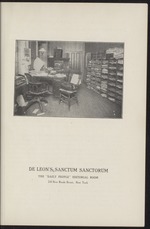
the time the Volkszeitung editorial attack was made, things
had already come to a head and the fight was on in earnest.
Tommy Morgan at Buffalo
Concurrently with this work of mining and sapping
within the Party organization, the same kind of work was
carried on in the C. L. F., the rather rotten filling in the warp
of the S. T. & L. A. Open conflict with the C. L. F. was
hastened when, in a Labor Day souvenir issued by that body,
advertisements of capitalist politicians appeared, and when
the body itself could not be made to take a decided stand
against the enterprising fakers...”
|
|
| 2 |
 |
“... majority could not hold its vote together to op-
pose such motions, some of their adherents not daring to
vote against, the result being that every such motion was car-
ried to so refer.
After that convention the S. T. & L. A. and the C. L. F.
parted company. Prior to that convention, the Volkszeitung
element and its co-conspirators within the Party used to ac-
cuse us loudly and lengthily for harboring in the S. T. & L. A.
such scamps as they declared that C. L. F. leading element
to be. After the convention, all sins being forgiven, both
these elements promptly fell into each others arms and joined
forces against the Party. The struggle was on.
Taxation Taxes Party Patience
The supreme test was soon to come. The situation pre-
sented several elements that must now be made clear. When,
as has already been mentioned, the New Yorker Volkszeit-
ung began to attack the Partys trade union policy openly in
its editorial columns. The People, of course, hit back and a
rather...”
|
|
| 3 |
 |
“...REMINISCENCES OF DANIEL DE LEON. 19
its wages and that, inferentially, the working class was, for
that reason, interested in the taxation policies of the capital-
ist political parties. This position was vigorously combatted
by De Leon, as the editor of The People, and by Vogt, the
editor of the German Party organ, the Vorwaerts. De Leon,
in an editorial article under the caption; Sign-Posts That
Will Have to Guide the Party for the Safe-keeping of a Daily
People, and published in The People of April 2, 1899, sum-
med up the entire register of Volkszeitung sins committed up
to that time. The Volkszeitung now felt the pressing need of
addressing itself also to the English-speaking portion of the
Party s membership, so as to make clear to that portion the
beauties of its taxation position.
Accordingly, there appeared, on April 29, 1899, a sheet
designated as the Monthly English Edition of the New
Yorker Volkszeitung, which, in the course of time, came to
be known as the...”
|
|
| 4 |
 |
“... it
could be accomplished, was a risk gladly assumed without
any qualms of conscience.
In 1899 it was not difficult for a Socialist to properly ap-
praise the true character of the A. F. of L.; and it was not
difficult on September 2, 1909, while today, in 1918, its true
character has become so unmistakable that it may readily be
discerned by "the man in the street, but while mountains
may heave and worlds may fall, so long as the New Yorker
Volkszeitung sees in the pure and simple unions the pasture
it must graze on, so long will it maintain its conception of
"economic determinism. And that, of course, carries with
it the defense of the A. F. of L. against the assaults of rev-
olutionary Socialism and the maintenance of that champion
of "Labor and Democracy as the united body of American
unionism.
Before closing this chapter, and taking leave of the New
Yorker Volkszeitung and its works, it is well to revert, once
more, to an editorial utterance of that paper in its...”
|
|
| 5 |
 |
“... May 13,
1914.
Here is the Volkszeitungs editorial. It is a "gem in
more ways than one that should not be left out of this vol-
ume but should be embalmed for future contemplation:
"DANIEL DE LEON.
He, who expired on Monday evening, fared as did so
many before him, he died a few decades too late; he outlived
himself.
"True to his maxim to destroy what he could not rule,
he concentrated, during the last fifteen years, his vitality
and will-power upon tearing down what he, personally, had
helped to create.
And therein he was great, far greater than in construc-
tion and erection. De Leon was, indeed, a destructive geni-
us, i. e., he was great in demolishing, in tearing down. With
an hatred that was insatiable and unstillable, he fought since
his entrance into the American labor movementsince 1892
against every movement of the working class of this coun-
try that showed success and that seemed to be in the as-
cendancy. It was contrary to his nature to perform con...”
|
|
| 6 |
 |
“...REMINISCENCES OF DANIEL DE LEON. 59
"Editorial Department Post Office Box 1576
Phone 129 Franklm
"DAILY PEOPLE
2, 4 and 6 New Reade Street
{Removed to 28 City Hall Place)
. "New York, August 3d, 1907.
Wm. D. Haywood,
"Denver, Colo.
"Dear Comrade:
uuch, I know, must have been the shower of congratu-
lations that poured upon you on your acquittal that I pur-
posely kept in the rear lest my voice be drowned by the mul-
titude. Moreover, how glad I felt needed no words; my
daily letter will have reached you promptly, anyhow.
Besides that, I had a special reason to wish to avoid
the crowd. What I now have to say I say banking upon the
message that your lawyer Miller delivered to me in your
name at Boise last April. He said you would have liked to
meet me and talk things over in the hope of coming to an
understanding. I am about to leave for Europe to the Inter-
national Socialist Congress. Things in America remain in a
disturbed and disordered condition. Nevertheless...”
|
|
| 7 |
 |
“...94 DANIEL DE LEONOUR COMRADE.
With solitary anguish wrong
Ive bitten this chastising tongue,
And thirsted, as I aimd the blow.
To clasp the bosom of my foe.
By coincidence I was reading Brand when an unusually se-
vere editorial appeared in The People castigating Debs. Hav-
ing read this, I turned back my pages and read aloud the
above quoted passage and then said: Boys, that is exactly
De Leon when he wrote that editorial. In fact, De Leon
was a BRAND in many important particulars.
A passage in a private letter also serves to make clear
this essential trustfulness, hopefulness, and belief in man.
This letter from which I quote was written to me in 1908,
after the split in the I. W. W.
As to my having been over-confident with regard to
some men, I must plead not guilty. My enemies charge me
with fighting people unnecessarily. Fact is I uniformly go
the full length, fullest length, possible of giving people the
opiportunity to show what good there is in them, if any...”
|
|
| 8 |
 |
“... lot of belated Kanglets with even
less sense and crazier than that senseless and crazy crew of
1902.
And again, on May 8, 1909, commenting upon the fact
that a Party Section had actually asked him to come and de-
bate some foolish charges made by a disgruntled and anar-
chistic individual that had just jumped out of the movement,
he wrote:
The enemy never gave me a single pang of sorrow. All
the pangs I have received came from the fool friends. To
think of such sleepy-headedness as to consider such a chal-
lenge, from such a source with anything but contempt and
laughter!
'De Leons working capacity was prodigious. During all
the fourteen years of the Daily People he wrote an editorial
nearly every day, and it was an editorial, not merely word.s,
a task which is no small one in itself. When these are once
collected and published, and there will be found to be some-
thing like six thousand of them covering the widest variety...”
|
|
| 9 |
 |
“...DE LEON'S-^SANCTUM SANCTORUM
THE DAILY PEOPLE" EDITORIAL ROOM
2-6 New Reaiie Street, New York...”
|
|
| 10 |
 |
“...DANIEL DE LEONOUR COMRADE. 97
I believe The People is devoted to the cause of hu-
manity?**
^^YeSj sirl Take a seat. What can 1 do for you?
Well,----1 am the reincarnation of Jesus Christ!
You don't say! Wonderful!
Yes! And I am the reincarnation of Napoleon!
^ Well, welll This is indeed remarkable!
^ Yes! And I am the reincarnation of Adam!
What! You dont mean to tell me____?
Yes! I am Adam reincarnated!
What, the whole of Adam?
Yes! The whole of Adam!
Iimpossible! Where does my share come in!?
Startled by this extraordinary demand, uttered in sten-
torian voice, the lunatic grabbed his hat and dashed out of
the editorial sanctum.
The secret of De Leons unusual working capacity I have
always laid a great deal to his remarkable ability of com-
plete mental relaxation, a secret which too few possess. De
Leon knew the full value of play, and knew how to extract
out of play all the good there is in it. He played physically
and he played mentally; he was always on...”
|
|
| 11 |
 |
“... Still exist in the editorial office of the Weekly Peo-
ple, I have no doubt that I would find a great deal of really
amusing evidence of this campaign of vicious slander, the only
weapons that the enemy really possessed against himargu-
ment and logic they never dared to try, for then their weapons
flew to pieces like wooden swords against steel.
Since I took charge of the office, I have found in a crev-
ice an old tablet on which De Leon had taken copious notes at
several Volkszeitung Association meetings in the Spring of
99. There we have them all photographed in the very first
onrush against De Leon and The PeopleJonas, Hillkowitz,
Koeln, Schneppe, Leib, and all the others. It is one long at-
tack on The People the tactics of the Party, its stand on the
question of taxation, and on the Socialist Trades and Labor
Alliance. How clearly the split was a split on the tactics of
the movement is shown by these notes.
In the pocket of another notebook from the days of 99, I...”
|
|
| 12 |
 |
“...132 DANIEL DE LEONOUR COMRADE.
original ideas had been proposed a dozen times before, and
that his most cherished plan had been tried and found wanting!
Nearly every assistant in the editorial officethe younger and
greener he was the surer he was to catch the diseasesoon
developed an ambition to sit in the chair, and conceived the
notion that it was a real mistake of the Party not to realize
that he should be there, and make the change at once. The
policies and tactics of the S. L. P. were very good, indeed, De
Leon should be given credit for having contributed to make
these clear, but he failed entirely when it came to making them
attractive to the massesin fact, as an editor, an organizer,
and a leader he was a back number, and if it was not for the
fact that he was a boss and an incurable egoist, he would rec-
ognize this and step aside and give place to number one!
How painful this subject really was to him may be seen
from the following story.
After one of the N...”
|
|
| 13 |
 |
“...WITH DE LEON SINCE 89. U
to make place for De Leon, vvlho up to that time had been as-
sociate editor.
Sanial pleaded old age and bad eyesight as the reason for
his res^naition, but the real reason, no doubt, was that he rec-
ognized in De Leon the superior man and above all the sys-
tematic, tireless and steady worker, who was equal to the big
job of making The People not a family paper filled with
plate matter (which is at all times of questionable quality), but
a paper filled with original matteran organ of a great move-
ment. a movement whose task it is to accomplish the greatest
revolution which has yet taken place in the history of mankind.
With De Leon in the editorial chair The People became
indeed a journal worthy of the great cause of international So-
th t*; K to Lucien Sanial.
that what ihe did write while a member of the Socialist Labor
Party was good, and that as a speaker and agitator he was a
man of marked ability; but the difference between him and...”
|
|
| 14 |
 |
“...18 WITH DE LEON SINCE '89.
mailed from St. Louis, though this was not generally known
by the subscribers.
The party adminisitration had no grounds on which to op-
pose the scheme at that time. De Leon and the National Exec-
utive Committee in New York knew that sooner or later the
scheme, like all sohemes, would spring a leak. And it did. The
post office authorities, when they discovered the deception,
compelled the publishers to mail the paper from the town
where it was dated, so the paper had to be sent by express to
the city where it was to appear as a local paper.
We in Troy, too, had our Labor experience. An old Ger-
man comrade was elected editor and I was elected manager.
I managed to get the 120 subscribers, and the local editor
edited the inches on the last page, at six cents an inch. Some-
times we lhad ten inches of local editorial matter, sometimes
more, depending upon the funds. As local manager, I had fre-
quent consultations with the local editor...”
|
|
| 15 |
 |
“... had
not yet arrived. Long before the split of 1899, when the Volks-
zeitung still claimed to be loyal to the Socialist Labor Party,
the members of the Volkszeitung Publishing Association were
as busy as bees in poisoning the minds of their compatriots, in
the German trade unions, sick and death benefit associations,
singing societies, and pinochle clubs.
Disrupters Narrow Selfishness
The Volkszeitung had its agents well distributed. In Cigar-
makers Union No. 90 it had, besides others, two brothers who
were both employes of the Volkszeitung, and both ex-
cigarmakers, and who still retained their membership in that
organization, although neither of them had made a cigar at the
bench for years. These were Adolph and Ludwig Jablinovsky;
one was in the business department, the other in the editorial
department of the Volkszeitung, and both were top-notchers
in the slander department. There was nothing that Adolph and
Ludwig disliked more than to be compelled to work in the...”
|
|
| 16 |
 |
“... Volkszeitung to put the loyal party members out
was not accomplished.
After an hours fighting the janitor put out the lights, and
the meeting of the general committee did not take place. Next
morning, however, the Volkszeitung published a notice calling
a meeting of the general committee for Monday, July 10, in a
hall on the Bowery. This, of course, meant bolting from the
Socialist Labor Party.
Rump Meeting on the Bowery
The office of the National Secretary of the Socialist Labor
Party and the editorial rooms of The People were on the third
floor at 184 William street, the building where the Volkszeitung
was published. This office of the National Secretary was rented
from the Volkszeitung Publishing Association. There another
battle royal took place between the opposing forces. This was
the memorable night of July 10, when the oppositionists tried
to capture the offices of the National Secretary and The People.
When it became known that the rump body would meet
on the Bowery...”
|
|
| 17 |
 |
“...68 WITH DE L-EON SINCE 89.
party headquarters. Reports soon came, however, that this
question was being discussed at the meeting on the Bowery
and finally that a raid had been decided upon. When that re-
port reached the party members who had assembled at 184 Wil-
liam street, they organized themselves to defend the S. L. P.,
its offices, and documents, if need be with their lives.
On the ground floor of the building at 184 William street
were the business office and the editorial room of the Volhs-
zeitung. On the third floor was the editorial room of The
People. This room De Leon shared with Vogt, the editor of
the partys German paper. On the same floor was the office
of the National Secretary of the party. Dividing Kuhns office
from that of De Leon there was a sort of ante-room w'here com-
mittee meetings were often held.
It was there that the loyal party members, about thirty in
number, were assembled awaiting the onslaught of the Volks-
zeitung reactionists. Ben...”
|
|
| 18 |
 |
“...70 WITH DE LEON SINCE 89.
party were to decide by a referendum vote. The power to elect
an editor was thus vested in the party. The Volkszeitung was,
however, in possession of the subscription money, mailing lists
and of everything except the editorial office. This circum-
stance was to have finished the job of killing the S. L. P. A
bogus People was now issued by the Volkszeitung; being in
possession of the mailing lists the Volkszeitung was in a posi-
tion to use these. But the bogus People, not only printed but
also edited by these gentlemen, was a sight to behold. It was
the incarnation of Aesops fable about the ass in a lions skin;
its braying deceived only children, or adults with a childs men-
tal faculties.
There were thus two papers printed, each claiming to be
the organ of the Socialist Labor Party. The bolters claimed
to be the S. L. P. The bogus People in the first week reached
the readers first, and the management of the Volkszeitung, hav-
ing been...”
|
|
| 19 |
 |
“... ago. The party members named it the
Daily People Flatiron Building, and it saw many of the strug-
gles that followed the ones of 1899.
All party institutions were housed in this building. The
basement was used by the mechanical department; the ground
floor by the Labor News Company, the partys literature agen-
cy; while the third floor was occupied by the editorial rooms.
On the top floor were the offices of the national secretary,
also of Section New York, and the national office of the So-
cialist Trade and Labor Alliance.
Dc Leons Sharp Discernment
De Leons room on the third floor was the point of the
triangle facing due east; a very small room it was, but with
plenty of air and morning sunshine. Here De Leon labored
day after day pondering over the difficult problems confront-
ing the Labor movement, and here he forged many a weapon
with which the arsenal of the Socialist Labor Party bristles
and which the workers will use some day to the undoing of
capitalist class...”
|
|
| 20 |
 |
“...WITH DE LEON SINCE 89.
m
stand all my sarcasm; that he had pretty broad shouldeis.
Whereupon I replied, Comrade Jaures, you may have broa4
shoulders, but they are not broad enough to carry the Kautsky
resolution to the members of the Socialist Labor Party m.
America. "
Sanial in concluding his report denounced the Social DeM-
ocratic Party whose delegates had of course voted in favor E
the Kautsky resolution. These were his closing remarks: "I
would rather have 36,000 men who are revolutionists and wh*
know what they want, than a million ninnies who dont know
what Socialism is. Two years later Sanial joined the ni-
niesnot only Sanial but quite a number of others who wcfc
functionaries of the party, agitators, organizers, members eS
the editorial staff of the Daily People, secretaries of state co-
mittees, writers in prose and writers in rhymeall went heltoi-
skelter down the incline from the heights occupied by the So-
cialist Labor Party. So many went down and with...”
|
|