| 1 |
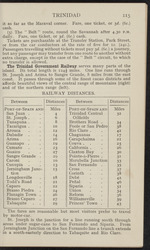 |
“... Miles
San Juan . 4 Trinidad Central 32
St. Joseph . 6 Oilfields
Tunapuna . 8 Brothers Road . 34
Tacarigua . IO Poole or San Pedro 38
Arouca 12 Rio Claro . 42
Dabadie 14 Chaguanas 17
Arima l6 Carapchaima 21
Guanapo . 19 Couva . 25
Cumuto 23 California . 26
Guaico 27 Claxton Bay 3°
Sangre Grande . 29 Pointe-a-Pierre . 3r
Caroni IO Marabella Junction 33
Cunupia 13 San Fernando . 35
Jemingham June- 15 Cross 37
tion Corinth 38
Longdenville 18 Debé 42
Todd’s Road 21 Penal 46
Caparo 22 Siparia 5t
Brasso Piedra 24 Union 34
Flanagin Town . 26 Reform 36
Brasso Caparo 27 Williamsville 39
Tabaquite 29 Princes’ Town . 43
The fares are reasonable but most visitors prefer to travel
by motor-car.
St. Joseph is the junction for a line running south through
areas under sugar-cane to San Fernando and Siparia. From
Jemingham Junction on the San Fernando line a branch extends
in a south-easterly direction to Tabaquite and Rio Claro....”
|
|
| 2 |
 |
“...
Anglicans, Presbyterians, Wesleyans, and Congrega-
tionalists, besides other Christian denominations, two
Roman Catholic convents, a Mohammedan mosque, and
a Hindoo temple.
The Ladies’ Self-Help Association, founded by Lady
Egerton, wife of Sir Walter Egerton, Governor from
1912 to 1917, occupies premises in Regent Street, where
curios may be purchased.
The Promenade Gardens are near the centre of the
city, and form with an esplanade called the Sea Wall
and the Botanic Gardens, the principal afternoon resort
of the people. The Sea Wall, which extends from Fort
William Frederick at the mouth of the Demerara river
to beyond Kitty Village on the east coast, was begun in
1858 and took thirty-four years to complete. It was
built mainly by convict labour with granite brought
from the penal settlement on the Mazaruni river. The
excellent band of the Georgetown Militia plays at these
places and the Botanic Gardens in rotation, one day a
week being devoted to each.
The Botanic...”
|
|
| 3 |
 |
“... on this were
deposited some seed of the courida. Then began the work of
building up an island which to-day is about two miles long by
one broad, and is known on the chart as “ Dauntless Island.**
For the convenience of visitors by the Canadian and
Harrison line steamers the Government Transport
Department arranges two day trips to the interior at
inclusive rates for parties of from 8 ($50.00 a head) to
20 ($40.00 a head). A party having been made up, a
telegram should be sent to “ Transport Demerara.”
The usual itinerary is :
Saturday. Leave Georgetown at 10 a.m. Cross the Demerara
river by ferry. Special train through sugar plantations and rice
fields to Parika. Leave Parika by steamer at 11 a.m. Arrive
at Fort Island at 12.30 p.m. Leave at 1.30 p.m. Arrive at Bartica
at 5 p.m. Leave at 6 p.m. Arrive at the Penal Settlement at
6.30 P.M.
Sleeping accommodation is provided on board the steamer
(four cabins, each with two berths), or in the Colony House (five
double...”
|
|
| 4 |
 |
“... junction with the Mazaruni, sprang into existence
during a gold boom, and was first known as Bartica
Grove, from a grove of mango trees there. It is still
the “ jumping off ” point for the diamond fields.
Beyond it to the north-west is the Penal Settlement,
for prisoners undergoing long terms of imprisonment,
on the fringe of the primeval forest.
From Bartica a motor-road, built with the help of a
loan from the British Government in 1930, runs to
Butukan, 54è miles to the south on the Essequibo River.
This enables travellers to the Potaro district to avoid
the falls and rapids between Bartica and Rockstone.
The Marshall Falls are the first of a series of rapids
encountered by diamond miners and gold-seekers
travelling up the Mazaruni, where boats have to be
hauled over. Barra-Carra is a picturesque little water-
fall.
At the confluence of the Cuyani and Mazaruni Rivers,
^ little to the south-west of the Penal Settlement, is
the site of the old Dutch fort of Kyk-over-al, or...”
|
|
| 5 |
 |
“... of party politics.
The Liberal party which came into power in 1906 declined to allow
Great Britain to be bound by the Penal Clause, and this led to
the High Contracting Powers passing an Additional Act ex-
empting her from her pledge to penalise bounty-fed sugar.
Meanwhile Russia, the only remaining Power which had
continued to give bounties on sugar, gave her adherence to the
Convention, but following a drought and a crop shortage on
the Continent she was, at the request of Great Britain, permitted
by a Protocol to export certain quantities of bounty-fed sugar
to western markets.
Notwithstanding this concession, it was announced in the
House of Commons on August, 1912, that the Government had
decided to withdraw from the Sugar Convention as from Septem-
ber 1st, 1913.
The Convention was denounced by France in 1917, and in
1918 the British Government gave formal notice of the with-
drawal of their pledge not to give a tariff preference to Colonial
sugar. In 1919 a...”
|
|
| 6 |
 |
“..., 172
" Partido ” tobacco, 354
Paso Real, 354
Passports, 27
Pater, Dutch freebooter, 405
Pearl, H.M. frigate, 319
Pearls (pink) from conchs, 293
Pedro Cays, 252, 297-8
Pedro Miguel, 417, 420, 426
Pegasus, frigate, 208
Pelée, la Montague, (or Pelé,
Mont), 5, 192, 244, 306
eruption of (1902), 310-2
Pelican Island, Barbados, 76
Pelican. Island, Trinidad, 118
Pembroke, Earl of, 73
Peiial, 115
Penal Settlement, British
Guiana, 378, 382, 383
Peniston’s Pond, 58
Penn, Admiral, captures
Jamaica, 254, 281
Pepper-pot, recipe for, 21
Perico, 416
Peter Island, 246, 248
Peterson, Lieut., the shooting
of, 207-8
Pétion, Haitian leader, 362
Pétionville, 364
Petit Martinique, 153
Petit Trous Beach, 148
Petroleum, 72, 108, 112, 137,
138, 140, 334, 335, 407,
443-4
Philippsburg, 335
Phillipsfield, 292
Phillipps, Capt. Samuel, 264
Phosphate of alumina, 214
Phosphate of lime, 248, 334
Piccadilly, Antigua, 209
Pickersgill, 374
Picton, Sir Thomas, 113,121
Pigeon Hill, 143...”
|
|