| 1 |
 |
“... ” in the tropics ; while for abstainers, lemonade,
ginger-ale, kola, and other " soft ” beverages can always
be obtained ; and lime squashes will be found infinitely
preferable to the more familiar lemon squash. Among
other beverages peculiar to the West Indies are pimento...”
|
|
| 2 |
 |
“...GENERAL INFORMATION
23
dram and falemum, while the old-time sangaree also
has its devotees. This drink, which is very refreshing,
consists of wine, water (perhaps), sugar, nutmeg, a slice
of lime, and an abundance of crushed ice. It is a good
rule to avoid all stimulants before the midday meal, or
at any rate until the sun has crossed the yard-arm. An
appetiser before dinner, which may take the form of a
cock-tail or a “ swizzle,” is recommended. The swizzle
is made from rum, gin, whisky, brandy, or vermouth,
mixed in a jug with bitters, grated ice, and a modicum
of sugar and frothed up with a swizzle-stick, the stem
of a plant with convenient radiating branches, apparently
provided by nature for this special purpose, which is
made to revolve backwards and forwards between the
palms of the hands. A recipe which it would not be
easy to beat is the old and familiar :
One of sour (lime juice),
Two of sweet (syrup),
Three of strong (rum), and
Four of weak (water).
In...”
|
|
| 3 |
 |
“... familiar scenes and amusements
on board ship, such as the daily “ sweep ” on the run,
the parade of the crew on Sunday, and the fiddles on
the tables in rough weather, leading inevitably to
reference to the concerts, fancy balls, sports, and so on,
which make the fortnight between London or Dover
and Barbados, or Avonmouth and Jamaica, and the
shorter journeys between Canada or the United States
and the West Indies pass so pleasantly for the traveller
who takes Charles Kingsley’s advice, and in respect of
his fellow-passengers is
To their faults a little blind ;
And to their virtues very kind.
Two days out the cold winds begin to lose their sting,
and on the third there is felt an appreciable change in
the climate, which becomes sensibly milder, even if the
weather is stormy.
After four or five days, the romantic group of islands
known as the Azores is passed. These Western Islands,
as they are also called, belong to Portugal, from which...”
|
|
| 4 |
 |
“...288 POCKET GUIDE TO THE WEST INDIES
or bread-kind, it appeared thickly wooded—mahogany, cedar,
mahoe, Santa Maria, and broadleaf being prominent, and
mosquito wood and red shingle wood, and other lesser known
woods being pointed out by our guide. ... As one rides along
these defiles the mournful note of the solitaire suggests the
nervousness which might have fallen on the soldiers marching
through a thickly wooded, rocky, unknown country, every crag
of which might conceal a foe, to whose foot such mountain paths
were familiar. At Maroon Town itself, we found a clearing on
which cattle were grazing, and a police station (just abandoned)
built on the site of the officers’ quarters of half a century ago.
Near by was the well which supplied the settlement with water,
and a barracks, some 130 feet long by 30 feet broad, which had
once possessed an upper story of wood, little now remaining of
the stoutly built lower walls of limestone quarried in the neigh-
bourhood. There...”
|
|
| 5 |
 |
“...CUBA
351
/erdad, Truth. Emerging from an open door is the
«ringed figure of Innocence, bearing a tablet inscribed
[mmunis, Guiltless.
The Cathedral, dedicated to the Virgin of the Im-
naculate Conception, stands near the junction of
Empedrado and San Ignacio Streets. It was built in
[704 by the Jesuits in the style familiar in Spanish
\merica with its twin towers and massive walls. When
Santo Domingo was ceded to France, remains, believed
to be those of Columbus, were removed to this Cathedral
with great ceremony, and here they remained until
1899, when, after the Spanish-American war, they were
transferred to Seville. It is now generally believed
that the remains in question were not those of the dis-
coverer, but of a member of his family (see page 366).
Other churches of note are those of Santo Domingo
(begun in 1578), Santa Catalina (1700), and La Merced
(1744), which has several oil paintings of merit.
On the Malecon the magnificent drive-way which
skirts the...”
|
|
| 6 |
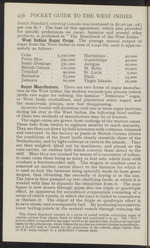 |
“...5,250,000 Martinique . . 40,090
550,000 Guadeloupe . 40,000
350,090 Antigua . 20,000
110,000 St. Kitts . 20,000
90,000 St. Lucia . . 2,000
65,000 Haiti. . 14,000
60,000 Virgin Islands . 10,000
I. There are two forms of sugar manufac-
436 POCKET GUIDE TO THE WEST INDIES
Dutch Standard entering Canada was increased to $1.00 (4s. 2d.)
per 100 lb.1 The text of this agreement, which also provided
for specific preferences on cacao, bananas and several other
products, is published in " The Handbook of the West Indies.”
West Indian Sugar Crops. The average annual output of
sugar from the West Indies in tons of 2,240 lbs. each is approxi-
mately as follows :
Cuba
Porto Rico
Santo Domingo
British Guiana .
Trinidad .
Barbados
Jamaica .
----------9 — ■ — - ' — . JL^JL OOCOO iniUVU
yields raw sugar for refining, the familiar “ Demerara " sugar,
or West India crystallised, and plantation white sugar) and
the muscovado process, now fast disappearing.
As every tourist will...”
|
|
| 7 |
 |
“... Avonmouth, the terminal port, but the late Sir Alfred
Jones, the originator of the enterprise, overcame all obstacles
and a successful trade was established. Elders and Fyffes now
have over thirty steamers bringing bananas from Jamaica and
Central and South America to England and the continent of
Europe, and in 1929 the Jamaica Direct Line was established
to carry Jamaica bananas to England and Europe.
The Jamaica banana, which is the variety known as the Gros
Michel, is cut when it is about three-quarters full, and conse-
quently tourists must not expect to see the fruit of the familiar
yellow colour growing on the trees in Jamaica, but quite green.
The smaller Canary banana (Musa Cavendishii) was exported ;
for some years successfully from Barbados, but the industry has
been suspended owing to lack of shipping facilities. The
two kinds of bananas were existing in the West Indies when
Père Labat visited the islands in 1696. The larger species was i
known as the " bananier...”
|
|