| 1 |
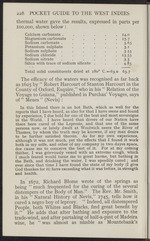 |
“...228 POCKET GUIDE TO THE WEST INDIES
thermal water gave the results, expressed in parts per
100,000, shown below:
Calcium carbonate ...... 14.0
Magnesium carbonate ..... 15.7
Sodium carbonate ...... 5.65
Potassium sulphate . . . . . .3.1
Sodium sulphate . . . . , . 3.55
Sodium chloride ...... 13-55
Sodium nitrate . . . . . 3.3
Silica with trace of sodium silicate . . . 4.85
Total solid constituents dried at 1800 C. = 63.o 63.7
The efficacy of the waters was recognised as far back
as 1625 by ” Robert Harcourt of Stanton Harcourt in the
County of Oxford, Esquire,” who in his “ Relation of the
Voyage to Guiana,” published in Purchas’ Voyages, says
of “ Meues ” (Nevis):
In this Island there is an hot Bath, which as well for the
reports that I have heard, as also for that I have seene and found
by experience, I doe hold for one of the best and most sovereigne
in the World. I have heard that divers of our Nation have
there been cured of the Leprosie, and that one of the...”
|
|
| 2 |
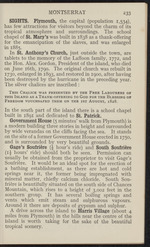 |
“... modem building three stories in height and surrounded
by wide verandas on the cliffs facing the sea. It stands
on the site of a former Government House erected in 1750,
and is surrounded by very beautiful grounds.
Gage’s Soufrière (| hour’s ride) and South Soufrière
(i£ horns’ ride) should both be seen. Permission can
usually be obtained from the proprietor to visit Gage’s
Soufrière. It would be an ideal spot for the erection of
a bathing establishment, as there are hot and cold
springs near it, the former being impregnated with
mineral matter, chiefly calcium chloride. South Sou-
frière is beautifully situated on the south side of Chances
Mountain, which rises to a height of 3,002 feet in the
southern group. It has several boiling springs and
vents which emit steam and sulphurous vapours.
Around it there are deposits of gypsum and sulphur.
A drive across the island to Harris Village (about 4
miles from Plymouth) in the hills near the centre of the
island is worth taking...”
|
|
| 3 |
 |
“...JAMAICA 283
and ferns, and many butterflies, as well as parrots,
parakeets, and other strange birds, are seen.
After leaving Spanish Town, the main line of the rail-
way proceeds through a fertile banana district to May
Pen, the junction for the Clarendon branch.
From there an expedition can be made to the ruins of
Colebeck Castle, which dates from the seventeenth
century. It was the residence of Colonel John Colebeck
who, as recorded on his gravestone in the Cathedral,
“ came with ye army which conquered this island."
At Milk River, 13 miles from May Pen station and
12 miles from Clarendon Park, there is a thermal mineral
bath. An analysis of its water gives the following
results:
Grains. Grains.
Chloride of sodium 20.77 Chloride of potassium 0.16
Sulphate of soda 3*4° Chloride of calcium 1.50
Chloride of magnesium 4.12
Besides traces of lithia, bromine, and silica.
It is claimed that the radio-active properties of the
Milk River spring compare very favourably...”
|
|
| 4 |
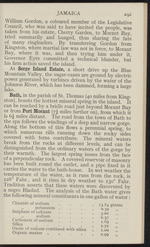 |
“... the windings of a deep and narrow gorge.
Along the bottom of this flows a perennial spring, to
which numerous rills running down the rocky sides
covered with ferns contribute. The mineral waters
break from the rocks at different levels, and can be
distinguished from the ordinary waters of the gorge by
their warmth. The largest spring issues from the face
of a perpendicular rock. • A covered reservoir of masonry
has been built round the outlet, and a pipe fixed in it
carries the water to the bath-house. In wet weather the
temperature of the water, as it runs from the rock, is
128° Fahr., and it rises in dry weather to 130° Fahr.
Tradition asserts that these waters were discovered by
a negro Bladud. The analysis of the Bath water gives
the following mineral constituents in one gallon of water :
Chloride of sodium
,, potassium
Sulphate of calcium
,, sodium
Carbonate of sodium
Silica
Oxide of sodium combined with silica
Organic matter . ,
13.84 grains.
°3*
5- or
6...”
|
|