| 1 |
 |
“...PREFACE
Every year our beautiful and historic possessions
in the West Indies attract an increasing number
of visitors from England, who find in them a
pleasant refuge from the rigour and fogs of winter.
To our American cousins these colonies have
long been a profitable hunting-ground for health
and enjoyment. For some little time, however,
no attempt has been made to provide the tourist
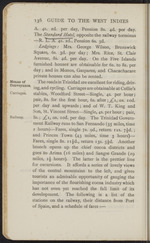
with a guide which, while including within its
scope all the islands more igenerally visited, as
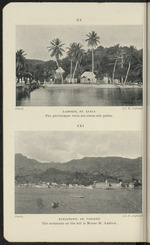
well as British Guiana and some of the foreign
islands, is still kept within such bounds as to
render it sufficiently condensed in form to permit
of its being carried in the pocket under a tropical
sun without inconvenience. Such a guide it is
the aim of the writer to provide. How far his
effort is successful, it must be left to the reader to
decide. If this small volume succeeds in inducing
a few to follow in the wake of Trollope, Froude
and Kingsley, who found so much happiness in a...”
|
|
| 2 |
 |
“...THE WEST INDIAN SEASON
1909—10.
Since this Guide was published few material altera-
tions have been made in the general arrangements
for visitors to British Guiana and the West Indies.
The principal change has been in connection with
Jamaica, Kingston having been practically destroyed
by earthquake and fire since this volume left the
printer’s hands. It is now being rapidly rebuilt;
but operations have hardly advanced sufficiently far
as yet to render it possible to describe the new city,
which will Be greatly superior to its predecessor in
every respect.
Under contract with the Government, The Royal Routes.
Mail Steam Packet Company now maintains a fort-
nightly intercolonial mail' service performed under
ordinary circumstances by the two new and yacht-
like steamers Berbice and Balantia (each 2500 tons,
twin screw) specially built to suit the West Indian
climate. The Company has arranged for a series of
independent and organised tours during the winter
from...”
|
|
| 3 |
 |
“...GENERAL INFORMATION
3i
are aboard, and the steamer is slipping down
Southampton Water, passing Netley on the left,
or the port side, as it should now be called. On
turning into the Solent, Cowes is seen, and then
in succession Yarmouth, Totlands Bay, Alum Bay,
and the Needles to the left, with Hurst Castle
standing out on a spit of sand to the right.
The pilot is dropped off the Needles, and the
steamer proceeds to Cherbourg, where passengers
are embarked that evening, and thence, under the
present arrangements, to Vigo, whose magnificent Vigo,
bay has been the scene of many naval engage-
ments. The town was assaulted and burnt by the
English under Drake and Norris in 1589; and,
on October 22, 1702, the combined English and
Dutch fleets attacked the French and Spanish
in the port. Several men-of-war and galleons
were taken and many destroyed, and an abund-
ance of plate and other valuable effects fell into
the hands of the conquerors. Vigo was taken
by Lord...”
|
|
| 4 |
 |
“...I
Telegrams.
Postal
Facilities.
38 GUIDE TO THE WEST INDIES
extensive free list. There is, however, no need to
give the tariffs, as genuine tourists are not troubled
by the customs authorities, and the regulations are
by no means so strict as they are at the most lax
custom-house on the Continent. Such articles as
tobacco, in any quantity, and also spirits in bulk,
are dutiable; but excellent cigars can be got in the
West Indies, and the latter from considerations of
health are best left behind.
British Guiana, and every island of importance,
with the exception of Nevis, Montserrat, the Virgin
Islands, and Tobago, are in telegraphic communica-
tion with the outside world by means of the cables
of the West India and Panama Telegraph Company,
Limited (Dashwood House, Old Broad Street,
London), and the Direct West India Cable Com-
pany, Limited (33 Old Broad Street, London);
and between Trinidad and Tobago, communication
has been established by radio-telegraphy...”
|
|
| 5 |
 |
“...6o GUIDE TO THE WEST INDIES
gets the full benefit of the north-east trade-winds,
and in the winter months the minimum mean
temperature at night falls as low as 63° Fahr.
The annual rainfall varies from about 50 to 70
inches. On the windward side, the climate is
especially invigorating, and the island is much
patronised by residents in neighbouring colonies
as a health resort. The death rate is not more
than 20 per thousand.
History. The actual date of the discovery of Barbados is
uncertain, but it is said that it was visited by
some Portuguese in 1536, who called the island
Los Barbudos after the bearded fig-trees which
/ they found there, and left behind them a stock of
pigs. It was not until 1605 that the British took
possession of the island. In that year the crew of
a vessel called the Olive Blossom, fitted out by Sir
Olave Leigh with stores and settlers for Guiana,
landed on the leeward coast and erected a cross,
inscribing on a tree near by, “ James K. of E...”
|
|
| 6 |
 |
“...7o GUIDE TO THE WEST INDIES
on a cairn of stones in memory of Bishop Rawle,
a former Principal. The best view of the college
buildings is obtained from this spot. On the left
is the Principal’s residence (1907, the Ven. Arch-
deacon Bindley), and on the right the college
proper, with lecture rooms, dining hall, and chapel
below, and the students’ quarters above, the whole
being by no means unlike the so-called “ New
Buildings ” at Magdalen College, Oxford. A
magnificent avenue of cabbage palms or palmistes
(Oreodoxa oleracea) leads from a portico, which
divides the chapel from the hall, to the foot of the
hill, and a row of these stately trees also fringes
the lake, contributing in no small degree to the
beauty of the scene. Many of these trees, which
are fully eighty feet in height, are computed to be
over one hundred years old. Kingsley first saw
cabbage palms, which form such a conspicuous
feature of West India scenery, in St. Kitts, and he
was much struck by...”
|
|
| 7 |
 |
“... afterwards, it was re-
quisite to open the vault again for an admission
of a member of the family, when the coffins
were found to have been displaced as on the
former occasion; the family now became anxious
to ascertain the truth, and particular pains were
taken in securing the wall, and fine sand was
thrown over the floor of the vault, so that, if a
person should enter it from any other part than
the usual entrance, marks might be left behind.
Lord Combermere was residing in 1820 in the
neighbourhood of the church, and, having been...”
|
|
| 8 |
 |
“...BRITISH GUIANA
79
The interior of the colony consists of swampy
grass plains called savannahs, dense forests and
bush, and ranges of mountains. The primitive
forests are only occupied by a few Indians, with
here and there a wood-cutter’s, a gold-digger’s, or I
a diamond-washer’s camp. A series of sandhills,
now covered by tall forest trees, runs parallel to
the sea-coast beyond the savannahs, and it is
supposed that they were left by the receding sea
in remote times. The highest of the mountains
is Roraima (8740 feet), which, though precipitous
near the summit, has been ascended on several
occasions, the first ascent having been made in
1884 by Mr. (now Sir) Everard im Thurn and Mr.
H. J. Perkins, who were also among the first to
visit the Kaieteur Falls on the Potaro, a tributary
of the Essequebo, which are of great grandeur.
The colony has four great rivers, the Demerara,
the Essequebo, and the Berbice, which give their
names to the three counties, and the...”
|
|
| 9 |
 |
“... 125 tons, owned by
Germans by birth but naturalised citizens of the
United States, left Baltimore for Curasao on 3rd
July 1799, commanded by Thomas Briggs, her
cargo consisting of dry goods, provisions, and
lumber. She put in at Oruba, and proceeded to
Port au Prince, in Hayti, and having carried
away her maintop mast she was making the best
of her way to the Isle of Ash, or Isle la Vache, a
small island off the south coast of Hayti, when,
on 28th August, she was captured by H.M.S....”
|
|
| 10 |
 |
“...,
were swallowed up by the opening of the earth,
which, when shut upon them, squeezed the people
to death, and in that manner several were left
with their heads above ground, and others covered
with dust and earth by the people who remained
in the place. It was a sad sight to see the harbour
covered with dead bodies of people of all conditions,
floating up and down without burial, for the burying
place was destroyed by the earthquake, which dashed
to pieces tombs, and the sea washed the carcases
of those who had been buried out of their graves.”...”
|
|
| 11 |
 |
“... 8s. njd., return 13s. sjd. Another
branch opens up the chief cocoa districts and
goes to Arima (16 miles) and Sangre Grande (29
miles, ij hours). The latter is the prettier line
for excursions. It affords a series of lovely views
of the central mountains to the left, and gives
tourists an admirable opportunity of gauging the
importance of the flourishing cocoa industry which
has not even yet reached the full limit of its
development. The following is a list of the
stations on the railway, their distance from Port
of Spain, and a schedule of fares :—...”
|
|
| 12 |
 |
“...156 GUIDE TO THE WEST INDIES
pletely overpowered by the Dutch, who remained
in sole possession of the whole island until 1662.
In that year the Dutch resigned the right to it,
and Cornelius Lampsius, one of the founders of
the colony, was created Baron of Tobago and
proprietor of the island under the Crown of
France. In 1664 the grant of the island to the
Duke of Courland was renewed. The Dutch
refused to recognise his title, and in 1666 the
island was captured by privateers from Jamaica.
A small garrison was left, but within a year it
was compelled to surrender to a few Frenchmen
from Grenada, who in their turn abandoned the
colony in 1667, leaving the Dutch in possession.
In 1672 Sir Tobias Bridges, with troops from
Barbados, broke up the Dutch settlement; but
the Dutch returned, only to be defeated by a
French fleet under Count D’Estrées after one
unsuccessful attack in 1677. Louis XIV. re-
stored the island to the Duke of Courland, who
in 1682 transferred his...”
|
|
| 13 |
 |
“...XX
Photo] ' - \A. B. AspinalA
LABORIE, ST. LUCIA
The picturesque trees are cocoa-nut palms.
XXI
Photo] lA.E.AspintOmt
KINGSTOWN, ST. VINCENT
The mountain on the left is Mount St. Andrew.
■v^éé
Wm
wg&iffSj
- '
~taéüÊi
mm...”
|
|
| 14 |
 |
“...ST. VINCENT
179
with its houses along the shore painted in the
same tints of blue or yellow or pink as those in
Norway, with the same red-tiled roofs, the trees
coming down the hill sides to the water’s edge,
villas of modest pretensions shining through the
foliage, with the patches of cane fields, the
equivalent in the landscape of the brilliant Nor-
wegian grass. The Government Offices, the Post Government
Office, and the Colonial Bank are within a stone’s Office
throw of each other near the centre of the town, Colonial
and Government House, the residence of the Government
Administrator, is at the back of the town above House-
the Botanic Garden, on the left-hand side looking
from the harbour.
The market is amusing during the busy hours Market,
early in the morning. A comprehensive view of
a large part of the island, with its picturesque
mountains and valleys covered with rich tropical
vegetation, can be obtained from the Mount St. Mount
Andrew (2600 feet), the...”
|
|
| 15 |
 |
“...ST. VINCENT
i»3
to disengage itself of its burden by the appearance
as of fire flashing now and then around the edge
of the crater. There was, however, no visible
ascension of flame. These flame-like appearances
were, I think, occasioned by the molten lava
rising to the neck of the volcano. Being quite
luminous, the light emitted was reflected from
the banks of steam above, giving them the ap-
pearance of flames.
“From the time the volcano became fully
active, tremendous detonations followed one
another so rapidly that they seemed to merge
into a continuous roar, which lasted all through
Wednesday night, yesterday (Thursday, the 8th),
and up to 6.30 a.m. this morning, the 9th instant.
These detonations and thunderings were heard
as far as Barbados, one hundred miles distant,
as well as in Grenada, Trinidad, and the south-
end of St. Lucia. At 12.10 p.m. on Wednesday, I
left in company with several gentlemen in a small
row-boat to go to Chateaubelair, where we...”
|
|
| 16 |
 |
“...ST. LUCIA
197
Port Castries, which is landlocked on three Principal
sides, is one of the prettiest and safest harbours 8 ® s'
in the West Indies. On entering, the breezy heights
known as Morne Fortunée are on the right, while
on the left is a promontory called La Vigée, on
which extensive barracks for the military were
completed before the decision to withdraw the
garrison from the island was arrived at in 1905.
At the head of the harbour are the Botanical Botanical
_ ... , , , • -Gardens.
Gardens, which now, through the enterprise of
Sir Daniel Morris, the Commissioner of Agricul-
ture, adorn what was formerly a reeking swamp.
Owing to the modern wharf and to harbour im-
provements, steamers are enabled to come along-
side at Castries and discharge cargo and passengers
without the intervention of boats.
The town Castries, so called after Marshal de
Castries, the French Colonial Minister in 1785,
stands at the top right-hand corner of the harbour.
The town...”
|
|
| 17 |
 |
“...ANTIGUA
205
be taken as any criterion of the climate, as it is
increased, as in so many West Indian colonies, by
the excessive infant mortality among the negroes.
Columbus discovered Antigua on his second History,
voyage in 1493, and christened it after Sta.
Maria la Antigua, a church in Seville. In 1629
D’Esnambuc made an abortive attempt to settle
the island, but he was driven away by want of
water, and it was not settled until 1632, when
some English from St. Kitts established themselves
there. During the Commonwealth it remained
Royalist, and was included with Virginia, Bar-
bados, and Bermuda in the Imperial Act of 1650,
which prohibited trade with those dependencies
on account of their rebellious attitude towards the
home Government. Lord Willoughby of Parham,
lessee of the patent left by Lord Carlisle to his
son, visited the Leeward Islands from Barbados
in 1650, and encouraged them to resist the
Commonwealth. He was compelled to relinquish
the government...”
|
|
| 18 |
 |
“...2io GUIDE TO THE WEST INDIES
curate of St. John’s, a white marble cenotaph to
the memory of the Hon. William Warner, a descen-
dant of Sir Thomas, and an elaborate monument to
Ralph, Lord Lavington, which were of exceptional
interest. In the latter his lordship was represented
in a sitting posture in court dress, with his plumed
hat lying at his feet, and two female figures reclin-
ing on either side of a small sarcophagus, the one on
the left representing Astrea, with her scales by
her side, and the other the genius of the island
mourning the loss of a favourite Governor. On
the base of the monument was a brief biographical
inscription. Then again there was a remarkable
monument to the memory of Mrs. Musgrave, who
was thrown out of her carriage in St. John’s, and
killed on the spot. A representation of the event
was sculptured in bas-relief on thë cenotaph,
which was of white marble. The present building,
however, contains very few monuments. Among
them the...”
|
|
| 19 |
 |
“...ANTIGUA
213
shot him dead on this very spot. The following
account of the episode is given in “ Antigua and
the Antiguans ”:—■
“ Lord Camelford commanded the Favourite
sloop of war, and Commodore Fahie the ship
Perdrix, Mr. Peterson holding the rank of first
lieutenant on board the last-named. Commodore
Fahie had left Antigua a short time before, to
take temporary command of the fleet, then anchored
before St. Kitts,1 and during his absence Lieutenant
Peterson was, of course, left in command of the
Perdrix. It was the custom, in those troubled
days of warfare, for boats to row backwards and
forwards across the harbour during the hours of
night, the sailors of the different ships in the dock,
headed by one of their officers, taking it by turns
to keep this watch; and the sleeper might often
be roused from his dreams as the deep-toned
“ All’s well ” resounded through the still night
air. Lord Camelford and Lieutenant Peterson
were unhappily at variance; and...”
|
|
| 20 |
 |
“...ST. KITTS
219
and therefore St. Kitts, which was settled by Mr.
(afterwards Sir) Thomas Warner at the suggestion
of Captain Thomas Painton, a seaman as enthusi-
astic as he was experienced, in 1623, can claim
the honour of being the mother colony of the
British West Indies. Warner revisited England,
and, on his return in 1625 with a number of
settlers, he landed on the same day as D’Esnambuc,
a privateering sailor from Dieppe, and in the face
of a common foe, the Caribs, the English and
French colonists settled down side by side, the
former in the middle of the island and the latter
at either end. A fierce battle was fought with the
Caribs, who though numerous were eventually
decimated, the survivors being chased into the sea.
The Spaniards resented the French and English
establishing themselves so strongly, and in 1629
they nearly annihilated the growing colonies. The
French left for Antigua and the English were
deported. A few of the sturdy French settlers...”
|
|