| 1 |
 |
“..., cassava, Indian corn, papaw,
pigeon peas, to mention a few only, while a
capital salad is made from the heart of the lofty
cabbage palm (Oreodoxa oleracea). It is, how-
ever, at dessert that the greatest surprises are
forthcoming. Bananas, both big (Gros Michel)
and dwarf (Musa Cavendishii), are known at
home, but the very small fig banana, or Lady’s
Finger, is not often seen out of the tropics, and,
while all fruit of this description tastes infinitely
better in its native home than in England or
America, the latter kind are for flavour the acme...”
|
|
| 2 |
 |
“...BARBADOS
59
amounting to nearly 2000 acres. The Chinese .
or dwarf banana (Musa Cavendishit) is also culti-
vated, and about 40,000 bunches are now shipped
from 100 acres of land. Manjak or glance pitch
is exported from several mines near the College
estate, to the extent of about 500 tons per
annum. Petroleum has been proved to exist in
Barbados, and the West India Petroleum Company
has incurred considerable expense in boring for
oil, but the industry has not yet been commercially
developed.
The financial position of the colony is shown financial
by the following comparative table of the revenue PoBition'
and expenditure, and the imports and exports, for
the last six years :—
Year. Revenue. Expenditure. Imports. Exports.
1900 . . ,£185,475 ,£176,982 ,£1.045,25. £919,011
1901-2 . . 179.973 .75,35° 1,031,679 950,175
1902-3 . . 161,585 194.346 872,679 592,464
1903-4 • ■ 180,831 176,309 821,618 552,891
1904-5 • • 185,056 .78,797 1,069,312 860,982
1905-6 . . 192,291...”
|
|
| 3 |
 |
“...ST. VINCENT
181
It also contains a large collection of plants of
economic interest, besides those of an ornamental
nature. It is one of the institutions under the
control of the Imperial Department of Agriculture
for the West Indies, and it serves as an efficient
centre for the propagation and distribution of
important industrial and other plants to local
planters. To visitors from temperate climes,
trees and plants, such as arrowroot, banana,
cannon-ball, cinnamon, cocoa, clove, black pepper,
bread-fruit, india-rubber, mango, mahogany, nut-
meg, pine-apple, teak, traveller’s palm, vanilla, and
various palms and ferns, can scarcely fail to be
of interest. The Government Central Sea Island The Cotton
Cotton Ginnery is situated within five minutes’Glnnery'
walk of the landing-stage, and should certainly
be visited. It is one of the best of its kind in
the West Indies, being capable of ginning and
baling upwards of 4000 lbs. of cotton lint per
working day of nine...”
|
|
| 4 |
 |
“...294 GUIDE TO THE WEST INDIES
The boucans have sliding roofs, which are closed
over them when, as is often the case in the middle
of the day, the sun is too powerful, or when it
comes on to rain. When the cocoa is quite dry
or “cured,” it is shipped in bags, each bag con-
taining roughly i £ cwt.
The Banana The only British West Indian colonies from
^ which bananas are now exported on a commercial
scale are Jamaica, Trinidad, and Barbados. In
Jamaica the industry has assumed enormous pro-
portions, no less than 15,000,000 bunches being
exported every year. The bulk of them go to the
United States, and the development of the trade has
been almost entirely due to American enterprise
and capital. Many years ago Captain Baker, the
commander of a schooner trading between Jamaica
and America, was in the habit of taking back to
his native town a few bunches of bananas, and
he found that they stood the journey so well, and
were so much appreciated by his friends, that he...”
|
|
| 5 |
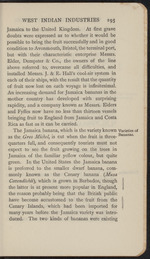 |
“...WEST INDIAN INDUSTRIES 295
Jamaica to the United Kingdom. At first grave
doubts were expressed as to whether it would be
possible to bring the fruit successfully and in good
condition to Avonmouth, Bristol, the terminal port,
but with their characteristic enterprise Messrs.
Elder, Dempster & Co., the owners of the line
above referred to, overcame all difficulties, and
installed Messrs. J. & E. Hall’s cool-air system in
each of their ships, with the result that the quantity
of fruit now lost on each voyage is infinitesimal.
An increasing demand for Jamaica bananas in the
mother country has developed with surprising
rapidity, and a company known as Messrs. Elders
and Fyffes now have no less than thirteen vessels
bringing fruit to England from Jamaica and Costa
Rica as fast as it can be carried.
The Jamaica banana, which is the variety known Varieties of
as the Gros Michel., is cut when the fruit is three- Bananas-
quarters full, and consequently tourists must not...”
|
|
| 6 |
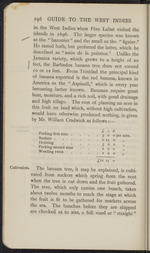 |
“...296 GUIDE TO THE WEST INDIES
in the West Indies when Père Labat visited the
islands in 1696. The larger species was known
^ as the “ bananier ” and the small as the “ figuier.”
He tasted both, but preferred the latter, which he
described as “amie de la poitrine.” Unlike the
Jamaica variety, which grows to a height of 20
ƒ feet, the Barbados banana tree does not exceed
10 or 12 feet. From Trinidad the principal kind
of banana exported is the red banana, known in
America as the “Aspinall,” which is every year
becoming better known. Bananas require great
heat, moisture, and a rich soil, with good drainage
and high tillage. The cost of planting an acre in
this fruit on land which, without high cultivation,
would have otherwise produced nothing, is given
by Mr. William Cradwick as follows :____
Forking first time .
Suckers .
Draining , .
Forking second time
Weeding twice
£ s* d,
• 300 per acre.
. o 14 o ,,
•500 „
* 200 „
. 100 „
£11 14 o
Cultivation. The banana...”
|
|
| 7 |
 |
“....
Has a cloud-capped summit which looks
like snow.
Shaped like a snake, or was perhaps once
infested with snakes.
A mountain near Barcelona in Spain.
Discovered on a Sunday.
So numerous, that they brought to mind
St. Ursula and the 11,000 virgins.
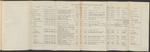
British since Area in Scj- Miles. Population. Principal Industries. Imports. 1 Exports. Mean of five years. Cost of Land per Acre. Chief Town. COLONY.
1783 4.466 58,175 Sponge, salt, fruit, fibre .£301,760 1 .£202,735 16s. 8d. Nassau. The Bahamas.
l6o5 v 166 199,542 Sugar, molasses, rum, cotton, banana, manjak 965,570 778,470 None Bridgetown. Barbados.
1803 1739 j IO0,OOo 7.562 278,328 40,327 Sugar, rum, molasses, cattle food, cocoa, coffee, rice, fruit, gold, diamond, timber Logwood, mahogany, fruit, rubber . . . 1,542,935 1,572,372 1,891,770 1,660,422 5d., 7^d. 4s. 2d. Georgetown. Belize. j British Guiana. British Honduras.
1655 4,207 639,491 Fruit, sugar, rum, coffee, dyewoods, pimento, molasses ,,801,710 1,803,070 & Kingston. i...”
|
|