| 1 |
 |
“...GENERAL INFORMATION 9
comer should guard against the tendency to increase the
quantity consumed which inevitably results from a
rising thermometer. The water in the principal towns
is, as a rule, quite drinkable; but itls bestto beonthe
safe side and to insist upon its being boded or filtered.
This is usually done by means of a Barbados drip-
stone,” a large block of coral rock hollowed into a con-
venient shape through which the water drips into a
receptacle below. Light wines or whisky and soda m
moderation are perhaps the safest drinks m the
tropics; while for abstainers, lemonade, ginger-ale,
kola and similar concoctions can always be obtained;
and lime squashes will be found infinitely preferable to
the more familiar lemon squash. Among other bever-
ages peculiar to the West Indies are pimento dram and
falemum, while the old-time sangaree also has its
devotees. The latter, which is very refreshing, consists
of wine, water (perhaps), sugar, nutmeg, a slice of...”
|
|
| 2 |
 |
“...GENERAL INFORMATION - it
of buggies, horses, motor-cars (in the larger places),
boats, and trains; but the tourist will be on the safe
side if he estimates his expenses on shore at from
£i ios. ($7.20) to £2 ($9.60) a day, without taking
into consideration what he may spend on those
delightful “ curios ” and souvenirs, the purchase of
which for friends at home is one of the pleasures of
travel.
MONEY. Visitors are recommended to carry letters
of credit from their bankers, which will be honoured
throughout the West Indies. British silver is the cur-
rency in the British West Indies; but British and
American gold is negotiable. Gold doubloons—the
old "pieces of eight” of the days of the buccaneers
—were finally withdrawn from circulation all over the
British West Indies in June, 1908. Public accounts are,
as a rule, shown in sterling ; but as banking and private
accounts are mainly kept in dollars and cents, and as
much trading is conducted on this basis, a table for...”
|
|
| 3 |
 |
“...io8 POCKET GUIDE TO THE WEST INDIES
vegetation. At a distance of about one hundred yards
from the mouth the cave divides at “ The Fork ” into
two branches, and from the side of the larger of these a
clear stream issues. The cave a little farther on becomes
most spacious, and forms a basin which has been called
“ the Bath,” but it then contracts again, and the outlet
of the stream has never been discovered, though an old
story is still current in the island that a duck was put
into the water at the end of the accessible part of the
cave and found a safe exit at Indian River in St. Michael.
Schomburgk says:
The duck, it is said, was exhausted and nearly stripped of its
feathers, perhaps by passing through fissures and coming in
contact with projecting rocks. The story is possible, but un-
likely ; unfortunately there is another version of it which says
that the duck was recovered in Scotland district.
Richard Blome, writing in 1672, says that these caves
were
often...”
|
|
| 4 |
 |
“... (population 763), on the north side, five miles
from Scarborough. The principal villages are Roxburgh
in the Windward district and Moriah in the northern.
Around the coast there are many excellent bays, most of
which are well sheltered and afford safe anchorage with
deep soundings. Indeed, Man-o’-War Bay, a very
spacious harbour, is said to be capable of affording shelter
to the whple of the British fleet! What is most wanted
for Tobago is the introduction of capital and labour ;
given that, there should be no reason why this beautiful
island should not regain a large portion at least of its
former prosperity. A hopeful feature is the number of
new settlers from the mother country who have acquired
plantations in different parts of the island. Grenadians,
too, after selling their cocoa plots in their own island to
the large proprietors, have been acquiring land. By their
industry and thrift they set a notable example to the
Tobagonians.
INDUSTRIES. The soil of Tobago is fertile...”
|
|
| 5 |
 |
“...ST. LUCIA 169
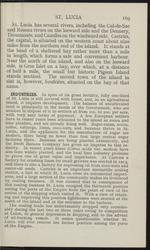
St. Lucia has several rivers, including the Cul-de-Sac
and Roseau rivers on the leeward side and the Tannery,
Trbumassée, and Canelles on the windward side. Castries,
the capital, is situated on the western coast about ninp
miles from the northern end of the island. It stands at
the head of a sheltered bay rather more than a milp
in length, which forms a safe and convenient harbour.
Near the north of the island, and also on the leeward
side, is Gros Islet on a bay, over which, at a distance
of half a mile, the small but historic Pigeon Island
stands sentinel. The second town of the island in
size is, however, Soufrière, situated on the bay of that
name.
INDUSTRIES. In spite of its great fertility, fully one-third
of St. Lucia is still covered with forest, and, as an agricultural
island, it requires development. The balance of uncultivated
land is principally in the hands of the Government, who are
aipaous to dispose of it to settlers at from 10s. to 20s...”
|
|
| 6 |
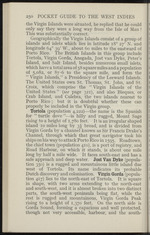 |
“... be included in the Virgin group.
Tortola (population 4,222)—the name is the Spanish t
for “ turtle dove ”—is hilly and rugged, Mount Sage M
rising to a height of 1,780 feet. It is an irregular shaped r
island 10 miles long by 3J broad, and is divided from I
Virgin Gorda by a channel known as Sir Francis Drake’s B
Channel, through which that great navigator took his c
ships on his way to attack Porto Rico in 1595. Roadtown, a
the chief town (population 410), is a port of registry, and 1
Road Harbour, on which it stands, is about one mile K
long by half a mile wide. It faces south-east and has a 1
safe approach and deep water. Jost Van Dyke (popula- i
tion 350) is a rugged and mountainous little island due I
west of Tortola. Its name indicates its probable j |1
Dutch discovery and colonisation. Virgin Gorda (popula- j t(
tion 417) lies to the north-east of Tortola. It is square 1
in shape, with two arms extending to the north-east j
and south-west, and it is almost broken...”
|
|
| 7 |
 |
“...JAMAICA 287
Jamaica, situated on the north coast near the west end
of the island, can be reached by the coast road by motor-
car in about eight hours (distance i28f miles). The first
place of importance passed is Annotto Bay (28! miles)
on the right bank of the mouth of the Wag Water
(a corruption of the Spanish Agua alta) river. This is
a shipping port on the railway line between Kingston
and Port Antonio. The quaint belfry of the Chapel in
the main street, which resembles an exaggerated meat-
safe, should be noticed.
Port Maria (44J miles) is a thriving port much fre-
quented by fruit steamers, which are loaded here with
bananas from St. Mary’s parish.
Oracabessa (51^ miles) is a small town but an important
fruit centre. The name is said to be derived from Cabeza
de oro, the " Golden'head.”
Ocho Rios (64! miles) is a small town with a well-
protected harbour of growing importance. The name
has been interpreted to mean “ eight rivers,” but it is
more probably...”
|
|
| 8 |
 |
“...292 POCKET GUIDE TO THE WEST INDIES
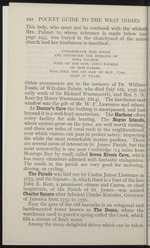
This lady, who must not be confused with the wicked
Mrs. Palmer to whom reference is made below (see
page 294), was buried in the churchyard of the same i,
church and her tombstone is inscribed :
UNDERNEATH THIS STONE
ARE DEPOSITED THE REMAINS OF
ROSA PALMER, ' ^11
WIFE OF THE HON. JOHN PALMER
OF THIS PARISH,
WHO DIED THE 1ST DAY OF MAY, I790,
AGED 72 YEARS.
Other monuments are to the memory of Dr. William '
Fowle, of Wiltshire Estate, who died July 6th, 1796 (an I
early work of Sir Richard Westmacott), and Mrs. S. N. 3
Kerr (by Henry Westmacott, 1814). The handsome east 1
window was the gift of Mr. W. F. Lawrence and others.'
At Doctor’s Cave the bathing is unsurpassed, and just c
beyond it is a well-kept sanatorium. The Harbour offers &
every facility for safe boating. The Bogue Islands, $
where oysters grow on the trees, are well worth visiting,. fl
and there are miles of coral reefs in the neighbourhood! '
over which...”
|
|
| 9 |
 |
“... salt Lake Enriquillo, whose surface is I
about 100 feet below sea-level, Monte Tina (over I
10,000 feet high), the Constanza Valley, the Falls at I
Jarabacoa, and Samana Bay. Interesting Indian |
remains are to be found, especially near San Juan in the I
West and Higuey in the East.
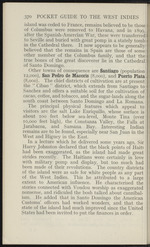
In a lecture which he delivered some years ago, Sir
Harry Johnston declared that the black points of Haiti
had been exaggerated, as the island had made great
strides recently. The Haitians were certainly in love
with military pomp and display, but too much had
been made of their revolutions. The country districts
of the island were as safe for white people as any part
of the West Indies. This he attributed to a large
extent to American influence. He characterised the
stories connected with Voudou worship as exaggerated
nonsense, and ridiculed the bosh talked about cannibal-
ism. He added that in Santo Domingo the American
Customs’ officers had worked wonders, and that the
state of the island...”
|
|