| 1 |
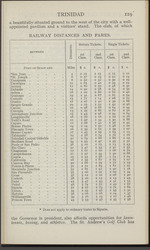 |
“... 52 x 48 x 00
Flan agin Town . 26 2 39 x 6x i 59 x 07
Brasso Caparo .... 27 2 45 1 65 I 63 1 xo
Tabaquite ..... 29 2 58 i 74 I 72 X 16
Trinidad Central Oilfields 32 2 79 1 88 x 86 I 25
Brothers Road .... 34 2 93 1 97 i 95 I 31
Poole or San Pedro 3« 3 20 2 15 2 13 I 43
Rio Claro ..... 42 3 47 2 33 2 31 I 55
Chaguanas ..... 17 1 61 I xo 1 06 0 72
Carapichaima .... 21 1 97 I 34 i 30 0 88
25 2 33 i 58 i 54 1 04
California . . 26 2 39 x 61 i 59 1 07
Claxton Bay .' . 30 2 66 x 79 I 77 1 19
Pointe-k-Pierre .... 3i 2 72 x 83 x 22
Marabella Junction 33 2 85 x 92 x 90 1 28
San Fernando . . . - 35 3 00 2 01 2 00 i 34
37 3 12 2 IO 2 08 1 40
Corinth 38 3 20 2 15 2 13 i 43
Debé 42 3 47 2 33 2 31 i 55
Penal . . . 46 3 74 2 51 2 49 I 67
Siparia ..... Si 4 07 2 73 2 71 x 82
Union ...... 34 2 93 i 97 I 95 i 3i
Reform ..... 36 3 06 2 06 2 04 i 37
Williamsville .... 39 3 26 2 19 2 17 x 46
Princes Town . . 43 3 53 2 37 2 35 1 58
* Does not apply to ordinary trains to Siparia...”
|
|
| 2 |
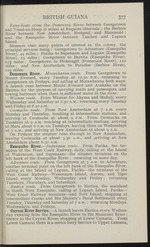 |
“... River,
If calling at the Island of Leguan, Parika—the terminus of the
I West Coast Railway—Wakenaam Island, Aurora, and Tiger
I Island every Monday, Wednesday and Friday; returning
I Tuesdays, Thursdays, and Saturdays.
Bartica route. From Georgetown to Bartica, the mainland
Bin South-West Essequibo, calling at Leguan Island, Parika—
I West Coast Railway terminus—and Fort Island, stopping at
[intermediate Creeks and His Majesty’s Penal Settlement every
I Tuesday, Thursday and Saturday at 7 a.m. ; returning Mondays,
I Wednesdays, and Fridays.
Cuyuni River Service.—A launch leaves Bartica every Wednes-
II day running from the Essequibo River to the Mazaruni River;
Ij thence to the Cuyuni River, stopping at Lower Camaria. From
|| Lower Camaria there is.a mötor-lorry Service to Upper Camaria,...”
|
|
| 3 |
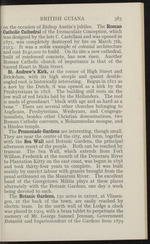 |
“..., besides other Christian denominations, two
Roman Catholic convents, a Mohammedan mosque, and
a Hindoo temple.
The Promenade Gardens are interesting, though small.
They are near the centre of the city, and form, together
with the Sea Wall and Botanic Gardens, the principal
afternoon resort of the people. Both can be reached by
tramcar. The Sea Wall, which extends from Fort
William Frederick at the mouth of the Demerara River
to Plantation Kitty on the east coast, was begun in 1858
and took thirty-four years to complete. It was built
mainly by convict labour with granite brought from the
penal settlement on the Mazaruni River. The excellent
band of the Georgetown Militia plays at these places
alternately with the Botanic Gardens, one day a week
being devoted to each.
The Botanic Gardens, 150 acres in extent, at Vlissen-
gen, at the back of the town, are easily reached by
electric tram. In the north wall of the Lodge a clock
was placed in 1909, with a brass tablet to...”
|
|
| 4 |
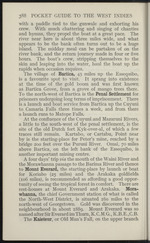 |
“...388 POCKET GUIDE TO THE WEST INDIES
with a paddle tied to the gunwale and exhorting his
crew. With much chattering and singing of chanties
and hymns, they propel the boat at a great pace. The
river near here is about three miles wide, and what
appears to be the bank often turns out to be a huge
island. The midday meal can be partaken of on the
river bank, and the return journey made in four or five
hours. The boat’s crew, stripping themselves to the
skin and leaping into the water, haul the boat up the
rapids when occasion requires.
The village of Bartica, 45 miles up the Essequibo,
is a favourite spot to visit. It sprang into existence
at the time of the gold boom and was first known
as Bartica Grove, from a grove of mango trees there.
To the north-west of Bartica is the Penal Settlement for
prisoners undergoing long terms of imprisonment. There
is a launch and boat service from Bartica up the Cuyuni
to Camaria Falls three times a week, and from there
a launch runs...”
|
|
| 5 |
 |
“... sugar-producing
Powers, and subsequently ratified by them, by which they
agreed to abolish bounties from September 1st, 1903, and to
render the existence of cartels impossible, by limiting the differ-
ence between the customs and excise duties. A Penal Clause
in this Convention provided that the High Contracting States
should impose a countervailing duty on, or prohibit the importa-
tion into their territories of, sugars from countries which granted
bounties either on production or export. Equality of oppor-
tunity in British markets was thus once more restored, and as
a result considerable developments took place in the British
West Indian sugar industry. It was agreed that the Convention
should remain in force for five years and thenceforward from
year to year, but the right was reserved to each of the Con-
tracting States of withdrawing on notifying such intention
twelve months before the expiration of the Convention.
On June 6th, 1907, Sir Edward Grey, on behalf of the...”
|
|
| 6 |
 |
“...436 POCKET GUIDE TO THE WEST INDIES
national Sugar Commission, established under the Convention,
sat to consider this proposition. Inasmuch as Russia was the ;
only bounty-giving Power of any consequence outside the
Convention, it became apparent from the first that the solution
of the difficulty would lie in the adhesion of Russia, and in the
direction of securing this the negotiations proceeded. Before
the close of 1907 it was announced that Russia had agreed to
adhere to the Convention, subject to the understanding that
she might maintain her fiscal and customs system, but should
not increase the advantage to the producers in the maximum
price fixed for sale on the home market. She engaged, more-
over, not to export more than one million tons of sugar during
the six years 1907-1913. An Additional Act to the Convention
releasing Great Britain from the obligations under the penal
clause, and a Protocol dealing with the adhesion of Russia,
were signed by all the...”
|
|