| 1 |
 |
“... elevation being
245 feet only. The islands are divided into nine parishes
—namely, St. George’s, Hamilton, Smith’s, Devonshire,
Pembroke (in which the capital is situated), Paget,
Warwick, Southampton, and Sandys. The total popu-
lation is about 22,500, of whom nearly half axe white-
many being the descendants of the early colonists1—and
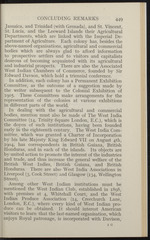
the remainder coloured.
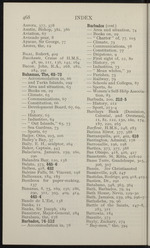
Bermuda is the headquarters of the North America
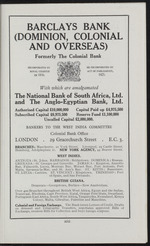
and West Indies station. The Commander-in-Chief
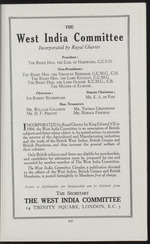
spends several months of the year in residence at
Admiralty House, and the presence of the Fleet during
the winter season contributes greatly to the social life
of the colony.
INDUSTRIES. The early settlers in the Bermudas were
planters, and the inhabitants followed agricultural pursuits
until the abrogation of the charter of the Somer Islands Company
in 1684 {see p. 46), when they took to trading. In vessels
made of the native cedar, they traded with the West Indies
and America, and carried salt fish from Newfoundland to...”
|
|
| 2 |
 |
“... Company, whose charter was extended to include the j
" Somer Islands ” as they were called ; and Richard Moore, ■
ship’s carpenter, was made first Governor. Three years later, j
the islands were sold to " the Governor and Company of the 1
City of London for the. Plantation of the Somer Islands,”
and they remained in the possession of that concern until 1684, j
when it was dissolved in consequence of the complaints of the
settlers.
At the beginning of the Commonwealth the Bermudians
remained Royalists, and, in company with Barbados, Antigua, j
and Virginia, the Bermudas were consequently penalised by
the Act of the Long Parliament which prohibited trade with
those colonies; but in February, 1652, the Governor and
Council took the oath of allegiance and the ban was removed.
Before passing from the history of the Bermudas the reader
may be reminded that the islands were immortalised by
Shakespeare, who no doubt derived his inspiration for the
opening scenes of “ The Tempest...”
|
|
| 3 |
 |
“..., was originated in Nassau by Dr. Cassel-
|berry. There are several Cricket Clubs and Rugby Football
is played during the winter. Duck shooting can be indulged in
fon Lakes Cunningham and Killarney from November to April;
Sand wild pigeon afford good sport in the summer months. The
1 sea fishing is varied and excellent and especially so round the
I* out ” islands. The bathing off Hog Island (see page 73) is
unsurpassable, and yachting and boating can be enjoyed with
perfect safety in the well-protected harbour.
CLUBS. The members of the Nassau Club and the Porcupine
[Club extend hospitality to visitors suitably introduced. The
[Porcupine Club on Hog Island, besides being a social club,
[makes excellent provision for bathing. All the “ Charter
[members ” are American. The subscription is $15 (£3 2s. 6d.)
(for two weeks, or $25 (£5.45. 2d.) for the season.
SIGHTS. Nassau (population 12,554), the capital of
[New Providence, a town dating from 1729, is pictur-...”
|
|
| 4 |
 |
“...-
rions without responsible government, They date from the
.oyal Charter of Charles I, June 2nd, 1627, and were confirmed
>y the Commonwealth in the articles of surrender of the island
ccJanuary nth, 1652. Next to the House of Commons
ind the House of Assembly in Bermuda, the Barbados House
f Assembly is the most ancient legislative body in the British
(ominions. The Government now consists of a nominated
legislative Council of nine members, and a House of Assembly
onsistmg of twenty-four members elected annually by thé
eople on the basis of a moderate franchise. At general elections
t) the latter body there is frequently no contest, a fact which
peaks volume? for the contented’state of the inhabitants, who
ff/er *P devote their time to the development of the island
Ether than to political strife, an sxample which might with
flvantage be followed elsewhere. The executive functions
E Government are performed bv an Executive Council
Inch consists of the Governor, the Colonial...”
|
|
| 5 |
 |
“...), which has
been granted a charter of incorporation, and stands
about sixteen miles inland from Port of Spain.
INDUSTRIES. The soils of Trinidad, though varied, are
extremely fertile, and are therefore capable of producing every...”
|
|
| 6 |
 |
“...304 POCKET GUIDE TO THE WEST INDIES
the parish of Kingston. The Morant Cays are 33 miles
to the south-east of Morant Port, and comprise three
small islets. Here the sea birds arrive in great numbers
in March and April and lay their eggs, which are con-
veyed by schooner to Jamaica. The Pedro Cays are
40 to 50 miles to the south-west of Portland Point, and
consist of four islets, known respectively as North-east,
Middle, South-west, and South Cay.
The Morant Cays and Pedro Cays are quite " off the
beaten track ” ; but a visitor to Jamaica in search of
experience and adventure might do worse than charter
a schooner and explore them. It is recorded that in
1825 some kindly Jamaica planters in St. Thomas-in-the-
East planted some coco-nut trees on the cays for the use
of shipwrecked sailors....”
|
|
| 7 |
 |
“... its commanding
situation. A settlement was also formed on Fort Island, near
the mouth of the Essequibo, which became the seat of govern-
ment of the colony of Essequibo—now one of the counties of
British Guiana. The date of the foundation of the settlement
at Kyk-over-al is uncertain, but it may be fixed at about 1620.
The settlement came into the possession of the Dutch West
India Company, which was incorporated in 1621 and became
by the terms of its charter supreme among all the Dutch
possessions in America. In 1624 the colony of Berbice—now
another county of British Guiana—was founded by Van Peere,
a merchant of Flushing, under licence from the company. The
central colony of Demerara was an offshoot from Essequibo,
and was established in 1645. In 1740 settlers from other
nations, mainly English, began to arrive from the West India
Islands in considerable numbers, the Dutch were quite out-
numbered, and Stabroek—now Georgetown—became a town of
importance. The Dutch and...”
|
|
| 8 |
 |
“...THE PANAMA CANAL
431
the outlets of the prehistoric volcano whose principal
cone was Ancon Hill.
Those interested in educational matters should not fail
to inspect the Institute Nacional, Panama’s University,
which was opened in 1911. It occupies a palatial group
of buildings at the foot of Ancon HUT.
Among the excursions that can be made from Panama
is the drive to Old Panama, which can be reached by
motor-car (enquiries should be made at the hotel) by
a fair driving road in about half an hour. In recent
years the local Government have cleared the ruins to
some extent, and the tower of the church and other
remains can be seen without discomfort. The city was
founded in 1519 by Pedro Arias de Avila, and was
granted a charter two years later. Being the entrepót
of the trade with Peru, it soon became very wealthy.
Here the treasure was transferred to mule-back, to be
carried across the Isthmus to Cruces, whence it was
conveyed to the fortified port of Chagres by boat...”
|
|
| 9 |
 |
“... made of The West India
Committee (14, Trinity Square London, E.C.), which is
the doyen of such institutions, having been founded
early in the eighteenth century. The West India Com-
mittee, which was granted a Charter of Incorporation
by his late Majesty King Edward VII on August 4th,
1904, has correspondents in British Guiana, British
Honduras, and in each of the islands. Its objects are
by united action to promote the interest of the industries
and trade, and thus increase the general welfare of the
British West Indies, British Guiana, and British
Honduras. There are also West India Associations in
Liverpool (3, Cook Street) and Glasgow (134, Wellington
Street).
Among other West Indian institutions must be
mentioned the West Indian Club, established in 1898,
with premises at 4, Whitehall Court, and the West
Indian Produce Association (14, Creechurch Lane,
London, E.C.), where every kind of West Indian pro-
duce can be obtained. It should interest American
visitors to...”
|
|
| 10 |
 |
“..., 74-112
— Accommodation in, 78
Barbados (cont.)
—• Area and situation, 74
— Books on, 29
— " Charter” of, 77, 105
— Climate, 75
— Communications, 78
— Constitution, 77
—— Dripstone, 9
— First sight of, 22, 80
— History, 76
— Industries, 75
— " Mean whites,” 39
— Parishes, 75
— Railway, 79
— Schools and Colleges, 87
— Sports, 80
— Women’s Self-Help Associa-
tion, 85
Barbuda, 200, 212-5
— History, 212
—- Sport, 213-4
Barclays Bank (Dominion,
Colonial, and Overseas),
n, 82, 122, 150, 160, 174,1
187, 220, 265
Barfleur, H.M.S., 248, 283
Barima River, 377, 388
Barranquilla, 401, 402, 410
Barrington, Admiral, 178
Barrouallie, 196, 198
Bartica, 373, 377, 388
Bas Obispo, 418, 426, 427
Basseterre, St. Kitts, 218-22
Basse Terre, Guadeloupe, 305,
306, 307
Bassin. See Christiansted
Bassinville, 238, 247
Bastidas, Rodrigo, 409, 418,419 .
Bastien, Dr., 291
Batabano, 348, 363, 364
Bath, Barbados, 79, 94
Bath House, Nevis, 229—30
Bath, Jamaica, 259, 289, 296-7...”
|
|
| 11 |
 |
“...BARCLAYS BANK
(DOMINION, COLONIAL
AND OVERSEAS)
Formerly The Colonial Bank
RE-INCORPORATED BY
ACT OF PARLIAMENT,
1925.
With which are amalgamated
The National Bank of South Africa, Ltd.
and The Anglo-Egyptian Bank, Ltd.
Authorised Capital £10,000,000 Capital Paid up £4,975,500
Subscribed Capital £6,975,500 Reserve Fund £1,100,000
Uncalled Capital £2,000,000.
INCORPORATED BY
ROYAL CHARTER
IN 1836.
BANKERS TO THE WEST INDIA COMMITTEE
Colonial Bank Office
LONDON . 29 Gracechurch Street . E.C. 3.
BRANCHES: Manchester, 21 York Street. Liverpool, 25 Castle Street.
Hamburg, Adolphsplatz iv. NEW YORK AGENCY, 44 Beaver Street.
WEST INDIES.
ANTIGUA: St. Johns. BARBADOS : Bridgetown. DOMINICA: Roseau.
GRENADA : St. Georges and Grenville. JAMAICA : Kingston, Annotto
Bay, Falmouth, Lucea, Montego Bay, Morant Bay, Port Antonio, Port
Maria, Savanna-la-Mar, and St. Ann’s Bay. ST. KITTS: Basseterre.
ST. LUCIA: Castries. ST. VINCENT: Kingstown. TRINIDAD : Port
of Spain, and...”
|
|
| 12 |
 |
“...THE
West India Committee
Incorporated by Royal Charter
President:
The Right Hon. the Earl of Harewood, G.C.V.O.
Vice-Presidents:
The Right Hon. the Viscount Burnham, G.C.M.G., C.H.
The Right Hon. the Lord Kylsant, G.C.M.G.
The Right Hon. the Lord Olivier K.C.M.G., C.B.
The Master of Elibank.
Chairman : Deputy Chairman :
Sir Robert Rutherford Mr. E. A. dePass
Hon. Treasurers
Mr. William Gillespie Mr. Thomas Greenwood
Mr. H. F. Previté Mr. Harold Freeman
T NCORPORATED by Royal Charter by King Edward VII in
A1904, the West India Committee is an association of British
subjects and firms whose object is, by united action, to promote
the interest of the Agricultural and Manufacturing industries
and the trade of the British West Indies, British Guiana and
British Honduras, and thus increase the general welfare of
their colonies.
Only British subjects and firms are eligible for membership,
and candidates for admission must be proposed by one and
seconded by another...”
|
|