| 1 |
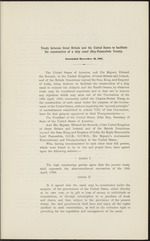 |
“... the United States of America;
And His Majesty Edward the Seventh, of the United Kingdom
of Great Britain and Ireland, and of the British Dominions
beyond the Seas, King, and Emperor of India, the Right Honourable
Lord Pauncefote, G.C.B., G.C.M.G., His Majesty’s Ambassador
Extraordinary and Plenipotentiary to the United States;
Who, having communicated to each other their full powers,
which were found to be in due and proper form, have agreed
upon the following articles:—
Article I.
The high contracting parties agree that the present treaty
shall supersede the afore-mentioned convention of the 19th
April, 1850.
Article II.
It is agreed that the canal may be constructed under the
auspices of the government of the United States, either directly
at its own cost, or by gift or loan of money to individuals or
corporations, or through subscription to or purchase of stock
and shares, and that, subject to the provisions of the present
treaty, the said government shall have and...”
|
|
| 2 |
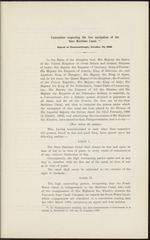 |
“... Majesty the Sultan, dated the 22nd February, 1866
(2 Zilk&dé, 1282), and sanctioning the concessions of His Highness
the Khedive, have named as their Plenipotentiaries, that is to say: —
(Here follow the names.}
Who, having communicated to each other their respective
full powers, found in due and good form, have agreed upon the
following articles:—
Article I.
The Suez Maritime Canal shall always be free and open, in
time of war as in time of peace, to every vessel of commerce or
of war, without distinction of flag.
Consequently, the high contracting parties agree not in any
way to interfere with the free use of the canal, in time of war
as in time of peace.
The canal shall never be subjected to the exercise of the
right of blockade.
Article II.
The high contracting parties, recognising that the Fresh-
Water Canal is indispensable to the Maritime Canal, take note
of the engagements of His Highness the Khedive towards the
Universal Suez Canal Company as regards the Fresh...”
|
|
| 3 |
 |
“...; and
The Government of the Republic of Panama, Philippe Bunau-
Varilla, Envoy Extraordinary and Minister Plenipotentiary of
the Republic of Panama, thereunto specially empowered by said
government, who after communicating with each other their res-
pective full powers, found to be in good and due form, have
agreed upon and concluded the following articles:—
Article I.
The United States guarantees and will maintain the indepen-
dence of the Republic of Panama.
Article II.
The Republic of Panama grants to the United States in
perpetuity the use, occupation, and control of a zone of land
and land under water for the construction, maintenance, operation,
sanitation, and protection of said canal, of the width often miles
extending to the distance of five miles on each side of the centre
line of the route of the canal to be constructed; the said zone
beginning in the Caribbean Sea three marine miles from mean
water mark, and extending to and across the Isthmus of Panama
into...”
|
|
| 4 |
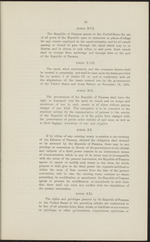 |
“... exemption is to be extended to the
auxiliary, railway for the transportation of persons in the service
of the Republic of Panama, or of the police force charged with
the preservation of public order outside of said zone, as well as
to their baggage, munitions of war, and supplies.
Article XX.
If by virtue of any existing treaty in relation to the territory
of the Isthmus of Panama, whereof the obligation shall descend
or be assumed by the Republic of Panama, there may be any
privilege or concession in favour of the government or the citizens
and subjects of a third power relative to an interoceanic means
of communication which in any of its terms may be incompatible
with the terms of the present convention, the Republic of Panama
agrees to cancel or modify such treaty in due form, for which
purpose it shall give to the third power the requisite notification
within the term of four months from the date of the present
convention, and in case the existing treaty contains no clause...”
|
|
| 5 |
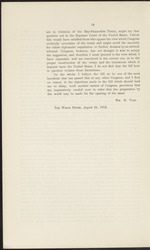 |
“...18
are in violation of the Hay-Pauncefote Treaty, might try that
question out in the Supreme Court of the United States. I think
this would have satisfied those who oppose the view which Congress
evidently entertains of the treaty and might avoid the necessity
for either diplomatic negotiation or further decision by an arbitral
tribunal. Congress, however, has not thought it wise to accept
the suggestion, and therefore I must proceed in the view which I
have expressed, and am convinced is the correct one, as to the
proper construction of the treaty and the limitations which it
imposes upon the United States. I do not find that the bill here
in question violates those limitations.
On the whole, I believe the bill to be one of the most
beneficial that has passed this or any other Congress, and I find
no reason in the objections made to the bill which should lead
me to delay, until another session of Congress, provisions that
are imperatively needed now in order that due...”
|
|