| 1 |
 |
“... Systematical part of this
Flora to cite all these plants, as I did in the first part of the
Flora of the W. I. Islands. In this latter case Suringar’s notes
sufficiently indicated the place, these islands being so much smaller
and easier to survey. It seemed sufficient in the second part of
the Flora to mention whether the plants had been collected by
Suringar in the islands or not.
The circumstance that I could not get the whole of Suringar’s
plants at my disposal during some time, rendered an extensive
account of his expeditions impossible and, in my opinion, super-
fluous, since nearly all parts visited by him were also studied by
myself, as will appear when his expeditions are compared with mine.
The labels of a great part of the Aruba plants show that many
of them were collected by Pastor v. Koolwijk, so that Koolwijk
is not a site, as the Symb. Antill. wrongly mentions in a few places....”
|
|
| 2 |
 |
“... plants personally, so that this recent collection coöld
be incorporated. The sites mentioned show that the following
spots were visited by the above mentioned gentlemen:
Willemstad and environs, Rif, Piscaderabaai, Mount Pleasant,
St. Martha, St. Kruis, Ascencion, Wacao, Patrick, St. Peter,
St. Jorisbaai, Caracasbaai.
Of nearly all plants doublets are found in the herbary of the
Botanical Laboratory at Utrecht.
It in possible that plants from Curasao are also present in a few
foreign herbaries. It appears, namely, from I. Urban, Symbolae...”
|
|
| 3 |
 |
“... Curasao, Aruba and Bonaire.
Moreover we see that in the Dutch W. I. Islands 22 species or
11% occur which are besides only found in South America,
while for Portorico these numbers are 6 species or 0.3 %•
This clearly proves that the flora of the three Dutch W. I. Islands
has a much greater resemblance with that of South America
than the Flora of Portorico has with the South American Flora.
All this refers only to the numerical distribution of the plants,
as given in the lists.
With regard to the flora of Portorico we cannot make comparisons
as to the plants, determining the vegetation. Our discussion in
the Third Part Section C will show, however, that the flora of
Curasao, Aruba and Bonaire shows in many respects strong
tendencies towards that of the Antilles.
1) I. Urban, 1. c., pp. 680, 681....”
|
|
| 4 |
 |
“...153
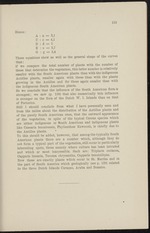
Hence:
A : a = 3,1
C : c = 4,1
D : d = 5
E : e = 3,7
G : g = 2,4
These equations show as well as the general shape of the curves
that: '.
if we compare the total number of plants with the number ot
those that determine the vegetation, this latter number is relatively
smaller with the South American plants than with the indigenous
Antilles plants, smaller again with these than with the plants
growing in the Antilles and for these again smaller than with
the indigenous South American plants.
So we conclude that the influence of the South American flora is
strongest; we saw (p. 139) that also numerically this influence
is stronger on the flora of the Dutch W. I. Islands than on that
of Portorico.
Still I should conclude from what I have personally seen and
from the tables about the distribution of the Antilles plants and
of the purely South American ones, that the outward appearance
of the vegetation, in spite of the typical Cereus. species which
are either...”
|
|
| 5 |
 |
“... Lantana camara,
Cordia cylindrostachya and Gundlachia corymbosa.
So the higher parts especially have a rather different vegetation.
The mountainous complex Behoenda and surrounding parts do
not reach the same height but in their plant species show much
resemblance with the Christoffelberg. The only conspicuous plant
I noticed there was Casearia bonairensis; besides the bush is
somewhat higher and denser in Behoenda than on the lower parts
of Christoffelberg.
The poorest vegetation is found on the barer non-calcareous hills,...”
|
|
| 6 |
 |
“...158
which are chiefly found in the Eastern part of Curasao. As a
specimen I choose
The Hills near Blauw.
On the almost bare ground stand widely scattered low small plants
of Evolvulus sericeus and Heliotropium humile, Aristida Swart-
ziana, Tragus racemosa, Paspalum glabrum, Sida procumbens. The
same sort of vegetation is found on
The Hills near Davelaar.
These are almost quite bare and show small complexes of some-
what higher Acacia villosa, Croton flavens and Caesalpinia coriaria,
but for the rest the only flora is formed by Bouteloua Humbold-
tiana and Aristida Swartziana, small plants of Jatropha gossypi-
folia, Evolvulus sericeus, Corchorus hirsutus, Tephrosia cinerea,
some Cereus plants, Sida procumbens and Diodia rigida. When
on these hills more Acacia tortuosa and some other shrubs deve-
lop, they are more overgrown. I mention as a specimen:
The Hills near Malpais.
Here is a rather dense shrub-growth of Croton flavens, Phyllan-
thus Euwensii, between which...”
|
|
| 7 |
 |
“... Poiretii,
Euphorbia thymifolia, Physalis, while on other spots a dense
mass of Coccoloba diversifolia is found. On the top and slope of
Brandaris also the little fern Dryopteris concolor occurs.
The lower parts of Bonaire outside the lime district.
These show also a Croton vegetation with Acacia tortuosa, Croton
Havens, Melochia tomentosa, Phyllanthus Euwensii, Randia acu-
leata as the most frequent shrubs, while also Capparis cynophal-
lophora, Capparis jamaicensis, Croton niveus, Malpighia punici-
folia, Pithecolobium unguis-cati are often found. The ground is cove-
red with ruderal plants, the same as in other parts of the island....”
|
|