| 1 |
 |
“... Rincon. I further mention here Mr. P.
van Teeckelenburg who put his house at my disposal for the
remainder of the time I spent on Bonaire.
On Febr. 20 I went to Curasao and returned to Holland on Febr. 27.
On Bonaire I received valuable help from Mr. Abelgaardo Eleonora,
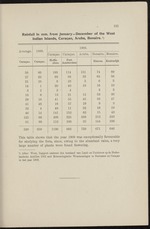
fusilier of the Infantry Corps of Curasao, whom Captain van
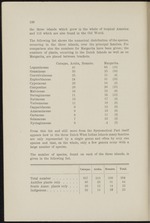
Hombracht had given me as guide.
Data about the vernacular names and the medicinal use of plants
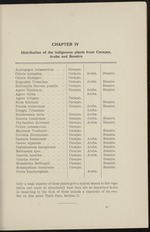
were chiefly furnished by Messrs. G. R. van Dussel, Dr. P. de
Haseth Möller, F. J. C. Beaujon, J. L. J. C. Cadières, de Wind,
A. Hermus, H. J. Cohen Henriquez, Th. van Sadelhoff and P. A.
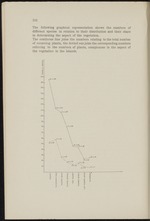
Euwens. Mr. Duyfjes gave me much informations about the geology
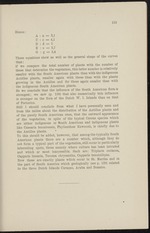
of the islands.
In the elaboration of the collected plants I was helped by Prof.
I. Urban who gave a number of indications for forms not directly
known to me, while Dr. F. Niedenzu, Dr. L. Radlkofer and Mr. 0.
E. Schulz named a number of the Malpighiaceae, Sapindaceae and
Solanaceae. Dr. H. Hallier...”
|
|
| 2 |
 |
“...X
Preface.
an extensive correspondence on forms that were difficult to deter-
mine. Thanks to his communications and assistance with the
determinations a number of plants have now been named with
greater certainty, than would have been possible without his
valuable help which was especially necessary with the Cactaceae.
This Flora is divided in Three Parts; whereas the different Parts,
Sections and Chapters need no further explanation, a short account
of the methods I followed in nomenclature, synonymy and distri-
bution of plants is given here.
The enumeration of Families and Genera is very nearly given
after the order of De Dalle Torre et Harms: Genera siphonoga-
marum ad systema Englerianum Conscripta (1908).
In a few cases I thougt it better to follow:
Urban: Symbolae Antillanae and Urban: Additamenta ad Cog-
nitionem Florae Indiae Occidentalis 1892—97.
The names of the species used are mostly drawn from these two
papers and Engler und Prantl.: Die natürlichen...”
|
|
| 3 |
 |
“...115
cinal use of many plants in Simon’s bookx) which also gives an
extensive list of vernacular and Latin plant names, composed by
Dr. N. Anslyn, military physician. That in such a list many inac-
curacies in the determinations occur is obvious.
I also became aequainted with a publication by Hurtado1 2),
who in an appendix gives a survey of the Curasao flora. This
appendix contains a very large number of mistakes.
It seemed preferable not to quote the plants from the three
publications mentioned and to elaborate in this flora only the
data from recent collections, found in the Utrecht herbary.
1) G. J. Simons. Beschrijving van het eiland Curapao. Oosterwolde 1868.
2) 0. Hurtado. Compendlo di botanica elemental. Curazao. Benthencourt e
Hyos. 1891....”
|
|
| 4 |
 |
“...118
A large portion of the Suringar collection has been deter-
mined by Prof. I. Urban and many plants from it are mentioned
in his Symbolae Antillanae.
Collection Aschenberg.
In the herbary of the Botanical Laboratory of het University
at Utrecht is a fairly large collection of plants, gathered in Curasao
by Aschenberg. I have not succeeded is obtaining nearer infor-
mation about it. It will be seen from the Systematical part of
this Flora that a great many of the species, found by Suringar
and myself, have also been collected by Aschenberg.
Collection F. A. F. C. Went.
A number of plants has been collected by Prof. Dr. F. A. F.
C. Went during his stay in Curasao in 1901. In the Systematical
list they are indicated by the name Went.
Collection Miss A. Lens.
In 1907 Miss Lens collected a number of plants in Curasao;
this small collection is conspicuous by its fine specimens, since
Miss Lens could take much time in drying them. They are chiefly
ruderal plants and...”
|
|
| 5 |
 |
“...121
Antillanae, III 1902, that the following persons visited Curasao
and collected plants in the various islands:
J. Ph. B. von Bohr (about 1737—1793) visited Curasao after 1786;
he sent plants from the Antilles to Prof. Vahl at Copenhagen.
It is possible that also in the Banks Herbary in the British
Museum, in the Martius Herbary at Brussels and in the Wildenow
Herbary at Berlin a number of plants from Curasao are found.
F. Bredemeyer (1758—1839) visited CuraQao about 1787, his col-
lections are in the K. K. Hofmuseum at Vienna and in the her-
bary of the Botanical Museum at Berlin.
J. Read also collected in Curasao; his collections are in the
Academy of Nat: Science at Philadelphia; West-Indian plants
also in the Krug und Urban Herbary at Berlin.
H. F. A. Baron von Eggers visited CuraQao in 1893; it is not
known to the present author whether he also collected plants there.
It did not seem advisable to spend time on a search for these
plants, since in all probability...”
|
|
| 6 |
 |
“... isolated moun-
tain and is surmounted by a caleareous table-land.
The diabase hilly complex, extending over a territory, bordered
by lines from Matavidiri to Belashi, from there to Boca Prins
and then along the North coast to Matavidiri, has a number of
high tops, among them Ariekok 175 M. and Jananota 188 M.
From these tops the country slowly descends to the South and
West and the whole landscape is dominated by cup-shaped hills,
separated by gently sloping valleys; in some places we find per-
pendicular walls. On the North coast we meet in a few places
the same limestone terraces which exist on the West coast of
Curagao.
Bonaire.
The West point of the island lies at ± 68° 12' W. Long, and
12° 14' N. Lat., the most Southern point at ± 68° 24' W. Long,
and 12° 13' N. Lat. The greatest length of the island is 36 kilo-
metres, its surface about 240 square kilometres. It consists of
a quaternary limestone formation, pierced in two places by moun-
tainous complexes of cretaceous...”
|
|
| 7 |
 |
“...131
Rainfall in mm. from January—December of the West
Indian Islands, Curasao, Aruba, Bonaire.1)
Average. 1899. 1909.
CuraQao. Curasao. Aruba. Bonaire. Bonaire.
Curasao. Curasao. Hoffle abau. Fort Amsterdam Rincon. Kralendijk
58 60 193 114 131 74 89
27 22 93 93 33 64 56
21 28 8 10 2 6 5
14 1 30 40 19 16 10
3 2 2 4 3 3
18 9 13 21 12 53 30
29 18 41 55 45 58 47
41 46 16 57 19 9 3
33 4 48 11 52 16 19
46 14 141 153 63 15 43
125 66 498 325 358 213 233
81 89 113 100 25 144 108
526 359 1196 983 759 671 646
This table shows that the year 1909 was exceptionally favourable
for studying the flora, since, owing to the abundant rains, a very
large number of plants were found flowering.
1) After: Went, Rapport omtrent den toestand van Land- en Tuinbouw op de Neder-
landsehe Antillen 1902 and Meteorologische Waarnemingen in Suriname en Curasao
in het jaar 1909....”
|
|
| 8 |
 |
“...
species and that, on the whole, only a few genera occur with a
large number of species.
The number of species, found on each of the three islands, is
given in the following list.
Curasao. Aruba. Bonaire. Total.
Total number 357 213 239 394
Antilles plants only 40 25 31 44
South Amer. plants only . . . 20 12 14 22
Indigenous 22 14 18 25'...”
|
|
| 9 |
 |
“...139
Hence the ratios of total number of the three groups are approxi-
mately as 360: 220: 250. The present author knows no reason why
this should be so; probably there is no connection with the ratio
of the surfaces of the islands which is as ± 360:119:153.
Taking into consideration all the wild plants, except those which
are also found in the Old World and in North and South America,
the three Dutch Islands share 106 plants or 25% more with.
South than North America and 42 plants or 10% more with
Central than North America. . . . ..
Comparing these numbers with the corresponding ones for the
flora of Portorico!), where they are 15 % and 7 %, we see that
the Dutch West Indian Islands contain relatively more Central
and South American plants than Portorico, although this island
has already a fairly large number of South American plants.
What Urban says (p. 681): „dass die Flora von Portorico die
st&rksten Beziehungen zu Siid-Amerika aufweist”, holds still more
for...”
|
|
| 10 |
 |
“....
Curagao. Aruba. Bonaire.
Curagao. Aruba. Bonaire.
Curagao. Aruba. Bonaire.
Curagao. Aruba. Bonaire.
Curagao. Aruba. Bonaire.
Curagao. Bonaire.
Curagao. Bonaire.
Curagao. Aruba. Bonaire.
Only a smal number of these plants give a typical aspect to the vege-
tation and occur so abundantly that they are an important factor
in imparting to the flora of these islands a character of its own.
See on this, point Third Part, Section C.
10...”
|
|
| 11 |
 |
“...150
are more or less predominant in the landscape and together with
the shrubs give it a uniform type, only modified by variations in
the numerical ratio in which the plants occur. This will make it
sufficiently clear that in the Leeward Islands differences in the
vegetation types as exist on the Windward Islands are not to be
expected. The type of vegetation on the Leeward Islands might
be generally described as a Croton vegetation, here as on the
Windward Islands determined by plants like Croton, Acacia,
Lantana, Melochia, Opuntia, Melocactus, to which for the Leeward
Islands may be added a number of other plants, as will appear
from the further description. On the Leeward still more than on
the Windward Islands this type of vegetation cannot be distinctly
separated from the litoral vegetation which only near the salt-pans
assumes a character of its own by the occurence of Mangrove
plants.
In many parts of the Islands culture or traces of former culture
are found...”
|
|
| 12 |
 |
“...151
Now since a large number of other plants abound as well on
lime’ as outside it, without being restricted to either of the two
soils it will be understood that only in a few cases and exactly
by the last named plants, when these occur in large quantities,
we can settle whether a caleareous or a non-caleareous vegetation
is present.
A& the result of these observations we have: . .
A litoral vegetation, difficult to separate from the principal
form the Croton-vegetation; this latter is determined by Acacia
and Croton and has either a Capparis type op a Rhacoma-Antirrhoea
type. In the higher parts this Croton-vegetation changes into a
more forestlike type; in general the predominant Cactuses are
found in the lower parts, although on Bonaire also some hills
are covered with them. The characteristic Rhacoma type is entirely
■ absent on Aruba, as this plant does not occur there.
The vegetation on Aruba receives a peculiar aspect through
Pithecolobium platylobum, which...”
|
|
| 13 |
 |
“...152
The following graphical representation shows the numbers of
different species in relation to their distribution and their share
in determining the aspect of the vegetation.
The continous line joins the numbers relating to the total number
of occurring plants, the dotted one joins the corresponding numbers
referring to the numbers of plants, conspicuous in the aspect of
the vegetation in the Islands.
170. _
140..
110. _
C = 106
100..
D = 80
G =22
h = 7
m...”
|
|
| 14 |
 |
“...153
Hence:
A : a = 3,1
C : c = 4,1
D : d = 5
E : e = 3,7
G : g = 2,4
These equations show as well as the general shape of the curves
that: '.
if we compare the total number of plants with the number ot
those that determine the vegetation, this latter number is relatively
smaller with the South American plants than with the indigenous
Antilles plants, smaller again with these than with the plants
growing in the Antilles and for these again smaller than with
the indigenous South American plants.
So we conclude that the influence of the South American flora is
strongest; we saw (p. 139) that also numerically this influence
is stronger on the flora of the Dutch W. I. Islands than on that
of Portorico.
Still I should conclude from what I have personally seen and
from the tables about the distribution of the Antilles plants and
of the purely South American ones, that the outward appearance
of the vegetation, in spite of the typical Cereus. species which
are either...”
|
|
| 15 |
 |
“...CHAPTER II
DESCRIPTION OF THE VEGETATION OF CURACAO,
ARUBA AND BONAIRE.
It appeared in Ch. I, p. 149 that in the three Islands no
sharp demarcation lines can he drawn between the various
types of vegetation. For this reason I shall not give an enume-
ration of the plants, belonging to the different vaguely distin-
guished regions, but prefer to describe some twenty-eight spots
in various parts of the islands, following entirely the locally col-
lected notes.
Curasao.
The Riff.
This extends near Willemstad on the West side along the
coast and consists of coral-lime with calcareous sand. It con-
tains a number of ruderal and typical litoral plants along the
sea-coast; the small lagunes are rich in Laguncularia racemosa,
Avicennia nitida and Rhizophora Mangle; Philoxerus vermicularis
occurs there as a herb together with Sesuvium portulacastrum;
also an occasional Cyperacea and Heliotropium curassavicum.
Morinda Royoc as a very low shrub together with Euphorbia...”
|
|
| 16 |
 |
“... together
with Haematoxylon Brasiletto and Machaonia Ottoms; in places
where the shrubs are less dense we find the soil pretty thickly
covered with Tephrosia cinerea, Heliotropium humile, Sida, Chlons,
Mariscus fuligineus, Hyptis pectinata and- Paspalum glabrum,
while Ipomoea winds through everywhere.
A few Bursera bonairensis and Antirrhoea acutata form again,
together with a, large number of Casearia bonairensis and Hae-
matoxylon Brasiletto, the higher shrubs or stick out with Hippo-...”
|
|
| 17 |
 |
“... number of
grasses coyer the soil. Croton niveus, Malpighia and especially
many Cephalocereus lanuginosus are- together with Guaiacum
officinale and Condalia Henriquezii the principal plants, while
here Metopium Brownei is already one of the tallest trees.
The lime district near Savonet.
Here the soil is more open in many places, the shrubs are less
high, so that Evolvulus, Heliotropium, Croton glandulosus, Sida,
and especially Sporobolus argutus are conspicuous; as a lower
shrub we see Kramera ixina; here, as in the above mentioned
regions, Cereus and Opuntia are seen everywhere in varying
numbers, while Cereus repandus is very frequent; on the grounds
towards the sea are many bare parts again, where Paspalum
glabrum is conspicuous and Cordia cylindrostachya is frequent
with Conocarpus erecta and forms whole complexes; there is
also found (the only place known to me) Amoreuxia palmatifida;
Jacquinia barbasco and Caesalpinia coriaria often stand quite iso-
lated, all very...”
|
|
| 18 |
 |
“... chrysantha, Guaiacum officinale and some, but not
many, Acacia tortuosa. In many places the shrub vegetation is
little developed and the ground is then covered by herbs and low
shrubs of which a number of ruderal plants attract notice, like:
Physalis, Spigelia anthelmia, Hyptis pectinata, Commelina virginica,
Sida supina, Mitracarpus villosus, Spermacoce tenuior, Turnera
pumilea, Elytraria squamosa, Bouteloua aristidoides, Evolvulus
alsinoides, Stylosanthes hamata, Pectis. Of the Cactaceae Cereus
griseus and Cephalocereus lanuginosus are conspicuous. In the
whole hilly complex of Mirlamar and Jamanota Pithecolobium
platylobum is very prominent, especially in the flowering season,
while also Malpighia forms large complexes. Poorer than on Mir-
lamar and its surroundings is the vegetation of
The Hills near Andikurie.
These are barer and we find on them only solitary trees of Coc-
coloba diversifolia, Capparis Breynia, Capparis jamaicensis, Caesalpinia
coriaria and Beureria...”
|
|
| 19 |
 |
“... Margarita.
From these numbers and more still from the figures of list p. 138,
appears that the flora of Margarita is numerically very different
from that of the Dutch W. I. Islands.
Margarita is much larger than the Dutch Islands. It is not only
its size, however, which causes the larger number of species but
still more the circumstance that higher mountains occur there,
reaching a height of 800 metres.
Although Johnston says (p. 301) that his flora probably does not
1) J. R. Johnston: Flora of the Islands of Margarita and Coche.
Contributions from the Gray Herbarium of Harvard University. New Series.
No. XXXVII (Printed June 1909)....”
|
|
| 20 |
 |
“...165
contain more than % of the real number of species, yet it seemed
to he desirable to compare this flora more closely with the plants,
mentioned in my Systematical part.
Johnston’s flora has 157 genera, not including Filices, which are
not found on Curasao, Aruba and Bonaire and of these some
70 have no representatives at a higher altitude than 300 metres,
while about 80 genera are only found above 300 metres.
So, if we compare the floras of the four islands we must not
include these genera, occurring above 300 metres.
Overagainst these 70 genera of the lower parts which were found
by Johnston and not by me, we have also some 70 which are
found on Curasao, Aruba and Bonaire but not on Margarita.
While the flora of Margarita mainly differs from that of the
Dutch -Leeward Islands by the occurrence of a peculiar flora in
the higher parts, it appears that of the 36 wild indigenous Antil-
les plants which are also found on Margarita, only 8 occur in
the Dutch Islands. So...”
|
|