| 1 |
 |
“... Rincon. I further mention here Mr. P.
van Teeckelenburg who put his house at my disposal for the
remainder of the time I spent on Bonaire.
On Febr. 20 I went to Curasao and returned to Holland on Febr. 27.
On Bonaire I received valuable help from Mr. Abelgaardo Eleonora,
fusilier of the Infantry Corps of Curasao, whom Captain van
Hombracht had given me as guide.
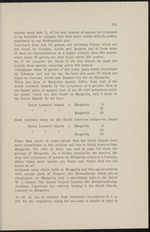
Data about the vernacular names and the medicinal use of plants
were chiefly furnished by Messrs. G. R. van Dussel, Dr. P. de
Haseth Möller, F. J. C. Beaujon, J. L. J. C. Cadières, de Wind,
A. Hermus, H. J. Cohen Henriquez, Th. van Sadelhoff and P. A.
Euwens. Mr. Duyfjes gave me much informations about the geology
of the islands.
In the elaboration of the collected plants I was helped by Prof.
I. Urban who gave a number of indications for forms not directly
known to me, while Dr. F. Niedenzu, Dr. L. Radlkofer and Mr. 0.
E. Schulz named a number of the Malpighiaceae, Sapindaceae and
Solanaceae. Dr. H. Hallier...”
|
|
| 2 |
 |
“... Pflanzenfamilien
up to 1914, Engler: Regnum Vegetabile up to 1914, or from other
monographs.
Whenever I could not find any name in the above mentioned
publications I took the name I thought best after the Internatio-
nal rules for Botanical Nomenclature chiefly of Vascular Plants.
Wien 1905. (Verh. Int. Bot. Congr. 1805 Wien.).
Besides the names thus given I also mention the synonyms that
are used in: Grisebach: Flora of the British West Indian Islands,
and in a very few cases still another one.
I tried to arrive at the greatest completeness possible in giving
the data about the names thus used, and I also mentioned the
pages where the plants occur in: Grisebach: Flora of the British
West Indian Islands.
To every plant is added the name of the Dutch West Indian
Windward Island where it is found in this order: Curagao, Aruba,
Bonaire.
I have mentioned as much as I could find about the distribution
of the plants in all parts of the world, and these data are taken
from the following...”
|
|
| 3 |
 |
“... attention although. I did not think
it necessary to collect it, I made some notes about it; these notes
are also to be found in this Flora, printed with small type.
As to the flowering and fruiting time of the plants I did not
think it necessary to mention with every plant whether I col-
lected flowers or fruits as the greater part of the plants have
been collected with flowers.
I wish to draw attention to the fact that I have tried to render
also this Flora of the Dutch West Indian Islands as complete
as possible, both by what my own investigations have taught me
and what I could find elsewhere.
Only the genus Melocactus has not been studied with the same
care, as I was sure I could not add anything to the work done
by Suringar on this head by the data I could bring together with-
out giving too much time to it. So I refer to the studies of
F. W. R. Suringar on Melocactus and those of J. Valckenier
Suringar.
Botanical Laboratory of the University
in Utrecht.
1913....”
|
|
| 4 |
 |
“...115
cinal use of many plants in Simon’s bookx) which also gives an
extensive list of vernacular and Latin plant names, composed by
Dr. N. Anslyn, military physician. That in such a list many inac-
curacies in the determinations occur is obvious.
I also became aequainted with a publication by Hurtado1 2),
who in an appendix gives a survey of the Curasao flora. This
appendix contains a very large number of mistakes.
It seemed preferable not to quote the plants from the three
publications mentioned and to elaborate in this flora only the
data from recent collections, found in the Utrecht herbary.
1) G. J. Simons. Beschrijving van het eiland Curapao. Oosterwolde 1868.
2) 0. Hurtado. Compendlo di botanica elemental. Curazao. Benthencourt e
Hyos. 1891....”
|
|
| 5 |
 |
“...CHAPTER II
NOTES ON THE COLLECTIONS.
Collection W. F. R. Suringar.
Dr. J. Valckenier Suringar has been so kind to put at my dis-
posal the diary of his late father Prof. W. F. R. Suringar about
his journey to the Dutch W. I. Islands in 1885.
From these data it has been possible to point out the expeditions
of this botanist in the three islands.
Suringar visited Curasao in 1885 from Jan. 10—28, Febr. 11—17,
Febr. 27- March 11, March 28—29, and made the following
expeditions
Jan. 10 Ft. Nassau, Altena, Pieter Maai.
n 12 Rif, plain near ’t Hospitaal, Priesterberg.
n 13 Hato, Gasparito.
9 14 Beekenburg, Spaansche water, Kabrietenberg, Zuurzak.
i) 17 Veeris.
7i 19 Westpuntbaai, Savonet.
n 20 Savonetbaai.
n 21 Christoffelberg.
7) 22 Savonet.
n 23 Tafelberg.
n 24 Tafelberg and Seroe trista.
n 25 St. Jan.
n 28 St. Jan, Schottegat.
Febr. 11 Zuikertuintje.
n 12 Brievengat, Ronde Klip.
13 Fuik, Fuikbaai.
n 14 Punt Canon, St. Barbara.
n 17 Klip near Willemstad...”
|
|
| 6 |
 |
“... this would not result in any new
information. _ (< . '
From N. J. Jacquin, Selectarum stirpium Americanarum historia
(1763), appears that at that time some sixteen plants from CuraQao
were already known, while also in Linn. Spec. (1753) a number
of data about CuraQao plants are spread....”
|
|
| 7 |
 |
“...PHYTOGEOGRAPHICAL
A. Orological, Geological and
Meteorological
CHAPTER I
GEOLOGICAL AND OROLOGICAL NOTES.
Introduction.
When preparing my journey to the three Leeward Islands I could
only avail myself of the Geological and Orological data from
K. Martin, Bericht fiber eine Reise nach Niederiandisch West
Indien, Leiden 1887.
At the time of my visit the Government was carrying out trian-
gulations on the three islands and also preparing a topographical
map of Curagao.
Besides a general sketch-map of the roads on Curagao, given me
by Mr. Zelle, Head of the Public Works Department there, and
a sketch-map of a part of Aruba, given me by Mr. R. J. Beaujon,
I had no means of orientation in the three islands.
The lack of maps made itself still seriously felt in 1910 (i. e. 23
years after the publication of Martin’s book); hence my topogra-
phical determinations are mostly based on local information.
During the preparation of this flora the Topographical map of
Curagao, on...”
|
|
| 8 |
 |
“...CHAPTER III
A comparison of the vegetation of Curasao, Aruba and
Bonaire with that of Margarita.'
As Margarita is an island not far from Curasao, and very elabo-
rately studied with regard to its florax), it is certainly worth
while to compare the floras of these four islands.
Johnston gives on page 297 a short comparison of the flora of
Margarita with that of Curasao, as it was known in 1909. He
arrives at the conclusion, based on the still very incomplete data
at his disposal (Suringar’s journey) that of the 117 known Curasao
plants 50 had not yet been found on Margarita.
At present it appears from my investigations in the Systematical
Part that of the 399 wild plants in the Dutch West Indian Islands
150 have also been found on Margarita. So we have:
Curasao, Aruba, Bonaire + Margarita 150
Curasao, Aruba, Bonaire 249
Margarita 440
399 590
These numbers diverge considerably from those given by Johnston
(p. 302), namely 400 for Curasao, of which 1Ó0 not on...”
|
|
| 9 |
 |
“... we have
Dutch Leeward Islands + Margarita 8
37
n i) »
Margarita 28
these numbérs being for the South American indigenous plants
Dutch Leeward Islands Margarita 2
20
n v » »
Margarita 38
These data prove to some extent that the Dutch Islands have
more resemblance to the Antilles and less to South America than
Margarita. We refer to what was said on page 129 about the
geology of Margarita. As a further peculiarity we mention the
very rare occurrence of grasses on Margarita, contrary to Curasao,
where many more species are found and where they are not
scarce at all.
Cactaceae cover whole fields in Margarita and this agrees entirely
with certain parts of Bonaire; the Bromeliaceae which are so
conspicuous on Margarita play a subordinate part in the Dutch
W. I. Islands. The typical tropical families like Melastomataceae,
Aroideae, Piperaceae are entirely lacking in the Dutch Islands,
contrary to Margarita.
As far as can be inferred from Johnston’s descriptions (1. c. p...”
|
|