| 1 |
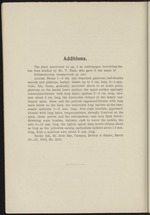 |
“...Additions
The plant mentioned on pg. 3 as Andropogon brevifolius Sw.
has been studied by Mi. V. Nash, who gave it the name of
Schizachyrium curasavicum sp. nov.
Annual. Stems 1—2 dm. tall, branched, glabrous; leaf-sheaths
smooth and glabrous, keeled; blades up to 8 cm. long, 3—4 mm.
wide, flat, linear, gradually narrowed above to an acute point,
glabrous on the keeled lower surface, the upper surface sparingly
tuberculate-hirsute with long hairs; spathes 2—3 cm. long; race-
mes about 2 cm. long, the internodes oblique at the deeply cup-
shaped apex, these and the pedicels appressed-hirsute with long
hairs below on the back, the internodes long barbate at the base;
sessile spikelets 5—6 mm. long; first scale involute, appressed-
hirsute with long hairs, long-acuminate, strongly 2-nerved at the
apex, these nerves and the intermediate ones very faint below;
flowering scale hyaline, delicate, cleft to below the middle, the
awn 8—12 mm. long, the tightly spiral deep brown...”
|
|
| 2 |
 |
“...157
succulenta; also Machaonia Ottonis and Bursera occur there.
On the ground grows not much more than a few Euphorbia
thymifolia and Phyllanthus polycladus.
The lime table land on Hieronymusberg.
This contains a similar vegetation, only somewhat poorer; here,
however, Guaiacum officinale and Guaiacum sanctum are conspicuous,
besides Phyllanthus Euwensii and Casearia bonairensis, Acalypha
Poiretii and Pisonia bonairensis.
Very divergent in its plant-growth by the presence of some forms
which are entirely lacking in other places is the
Christoffelberg. _ .
At its base we find again the strongly developed Croton vegetation
of the lower hilly country, which besides Cactuses also contains
many Croton flavens, Jatropha gossypifolia, Acacia villosa, Haema-
toxylon Brasilettq* Cordia cylindrostachya, Jatropha urens, Acacia
tortuosa, Melochia tomentosa, Randia aculeata and Phyllanthus
Euwensii. Also the lower Sida species, Indigofera suffrutieosa,
Convolvulaceae and Opuntia...”
|
|