| 1 |
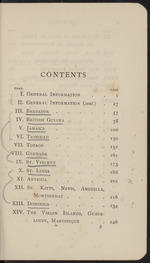 |
“...CONTENTS
CHA'- PAGE
I. General Information . . i
C II. General Information (coni.) . 27
. III. Barbados . . . . *57
\ IV. British Guiana . . . . 78
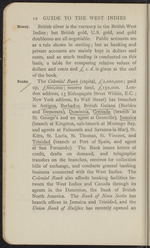
V. Jamaica * . . , 100
^ VI. Trinidad.........................
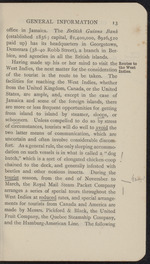
\ VII. Tobago . - _ rj2
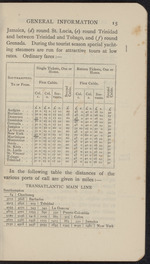
^VIII. Grenada......................jgj
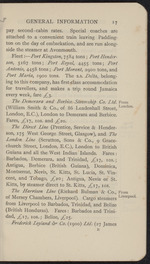
IX. St. Vincent . -173
■ X. St. Lucia....................X88
< XI. Antigua.........................
f XII. St. Kitts, Nevis, Anguilla,
Montserrat . . . .216
^ XIII. Dominica . .
- .................234
XIV. The Virgin Islands, Guade-
loupe, Martinique . . 246
« A...”
|
|
| 2 |
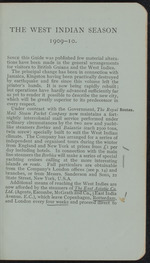 |
“...THE WEST INDIAN SEASON
1909—10.
Since this Guide was published few material altera-
tions have been made in the general arrangements
for visitors to British Guiana and the West Indies.
The principal change has been in connection with
Jamaica, Kingston having been practically destroyed
by earthquake and fire since this volume left the
printer’s hands. It is now being rapidly rebuilt;
but operations have hardly advanced sufficiently far
as yet to render it possible to describe the new city,
which will Be greatly superior to its predecessor in
every respect.
Under contract with the Government, The Royal Routes.
Mail Steam Packet Company now maintains a fort-
nightly intercolonial mail' service performed under
ordinary circumstances by the two new and yacht-
like steamers Berbice and Balantia (each 2500 tons,
twin screw) specially built to suit the West Indian
climate. The Company has arranged for a series of
independent and organised tours during the winter
from England and New York at prices...”
|
|
| 3 |
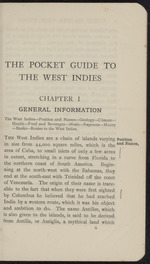 |
“...THE POCKET GUIDE TO
THE WEST INDIES
CHAPTER I
GENERAL INFORMATION
The West Indies—Position and Names—Geology—Climate—
Health—Food and Beverages—Meals—Expenses—Money
—Banks—Routes to the West Indies.
The West Indies are a chain of islands varying Position
in size from 44,000 square miles, which is the 8110 Names-
area of Cuba, to small islets of only a few acres I
in extent, stretching in a curve from Florida to '
the northern coast of South America. Begin-
ning at the north-west with the Bahamas, they
end at the south-east with Trinidad off the coast
of Venezuela. The origin of their name is trace-
able to the fact that when they were first sighted /
by Columbus he believed that he had reached
India by a western route, which it was his object
and ambition to do. The name Antilles, which
is also given to the islands, is said to be derived
from Antilla, or Antiglia, a mythical land which
A...”
|
|
| 4 |
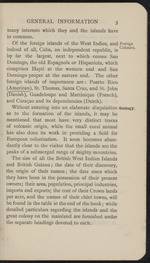 |
“...GENERAL INFORMATION 3
many interests which they and the islands have
in common.
Of the foreign islands of the West Indies, and Foreign
indeed of all, Cuba, an independent republic, is CoIonies'
by far the largest, next to which comes San
Domingo, the old Espagnola or Hispaniola, which
comprises Hayti at the western end and San
Domingo proper at the eastern end. The other
foreign islands of importance are: Puerto Rico
(American), St. Thomas, Santa Cruz, and St. John
(Danish), Guadeloupe and Martinique (French),
and Curasao and its dependencies (Dutch).
Without entering into an elaborate disquisition Geology,
as to the formation of the islands, it may be
mentioned that most have very distinct traces
of volcanic origin, while the small coral animal
has also done its work in providing a field for
European colonisation. It soon becomes abun-
dantly clear to the visitor that the islands are the
peaks of a submerged range of mighty mountains.
The size of all the British West Indian Islands
and...”
|
|
| 5 |
 |
“...GENERAL INFORMATION 5
are subject to occasional hurricanes in August,
September, and October; but, fortunately, such dis-
turbances do not come without warning, and due
notice of their approach is signalled from stations
of the United States Weather Bureau, the signal
being two red flags with a black centre hoisted
one above the other. > Hurricanes of such violence
as to cause serious damage to buildings or loss of
life are, happily, nöt frequent in any given place.
For example, Montserrat, which suffered from a
hurricane in 1899, had, it is said, previously en-
joyed immunity for upwards of one hundred years.
Volcanic eruptions are confined to the Mon-
tagne Pelée in Martinique and the Soufrière in
St. Vincent, both of which had been quiescent for
very many years prior to the trouble of 1902, and
seismic movements are generally so slight as to
be scarcely noticeable. During January, Febru-
ary, and March the north-east trade-winds blow
with great regularity, rendering these months par-...”
|
|
| 6 |
 |
“...GENERAL INFORMATION
7
The question of food and beverages in the West Food and
Indies is one which deserves a few remarks. To Be76rages-
a visitor fresh from temperate climes, both pre-
sent decided features of novelty. Beef and mutton
find their places on the board, though, owing to
the climate, they are as a rule tough, except in the
larger islands, in which supplies from the United
States are obtainable. Chicken and guinea-fowl
figure extensively on the menu, but, beyond these,
a tropical table differs materially from one at
home. This is chiefly the case in so far as
concerns the fish and vegetables. Of the former
there are the flying-fish—the dish par excellence
of Barbados, and very good it is, too—snapper,
snook, mullet and grouper, all of which are
deservedly popular. Among the vegetables are
yams—floury and soft to the palate—sweet pota-
toes, tannias, eddoes, ochros—the pods of which,
cooked like asparagus, are excellent—plantains,
delicious when fried, cassava, Indian corn, papaw...”
|
|
| 7 |
 |
“...GENERAL INFORMATION 9
a quarter hours, and then boiled again next day
for half-an-hour. On the third day the pepper-
pot will be ready for table. The pot must be
constantly replenished, and if heated up day after
day it will last for many years: in fact, if carefully
tended, the older it is the better. Indeed, the
writer has been privileged to partake of a “ pepper-
pot ” said to be over one hundred years old.
In Dominica and the French islands the edible
frog known as the crapaud (Hana esculc?itci) is
considered a great delicacy, and, one might add,
very succulent. It is served to unsuspecting visitors
under the name of “mountain chicken.” The
iguana, a tree lizard, also furnishes a palatable
dish, while gru-gru worms, large maggots—as
for want of a more appropriate name they must
be called—found in the growing heart of the palm
trees, are also looked upon as a choice luxury.
The taste in regard to beverages in the West
Indies follows very closely that prevailing at home;
but a new-comer...”
|
|
| 8 |
 |
“...GENERAL INFORMATION
ii
at sea, there are, after the ticket has been paid
for, no expenses except for wines, &c., and the in-
evitable tips. With regard to the latter, it may be "Tips.”
mentioned that to ensure the best attendance it is
a good plan to give the cabin steward and waiter
their tips in two instalments, half at the begin-
ning of the voyage, with a promise of further
largess if satisfaction is given. * For a voyage of
twelve days it is usual to give the cabin steward
£1, the waiter at table ios., the bathroom steward
5s., and the boots 2s. 6d. On shore, ten percent,
of the amount of the charge or bill will be found
to be a good basis for calculating the amount of
tips. At most of the hotels and lodgings in the Hotels and
West Indies, from 8s. 4d. to 12s. 6d. per day is Lodgings'
the minimum charge for board and lodging. Added
to this must be the expenses of various expeditions,
involving the use of buggies, horses, boats and
trains but the tourist will be on the safe side
if...”
|
|
| 9 |
 |
“...in Antigua, Barbados, British Guiana (Berbice
and Demerara), Dominica, Grenada (brancfT'at
St. George’s and an agent at Grenville), Jamaica
(branch at Kingston, sub-branch at Montego Bay,
and agents at Falmouth and Savanna-la-Mar), St.
Kitts, St. Lucia, St. Thomas, St. Vincent, and
Trinidad (branch at Port of Spain, and agent
at San Fernando). The Bank issues letters of
credit, drafts on demand, and telegraphic
transfers on the branches, receives for collection
bills of exchange, and conducts general banking
business connected with the West Indies. The
Colonial Bank also affords banking facilities be-
tween the West Indies and Canada through its
agents in the Dominion, the Bank of British
North America. The Bank of Nova Scotia has
branch offices in Jamaica and Trinidad, and the
Union Bank of Halifax has recently opened an...”
|
|
| 10 |
 |
“...GENERAL INFORMATION 13
office in Jamaica. The British Guiana Bank
(established 18365 capital, $1,400,000, $926,520
paid up) has its headquarters in Georgetown,
Demerara (38-40 Robb Street), a branch in Ber-
bice, and agencies in all the British islands.
Having made up his or her mind to visit the Routes to
West Indies, the next matter for the consideration todies^
of the tourist is the route to be taken. The
facilities for reaching the West Indies, whether
from the United Kingdom, Canada, or the United
States, are ample, and, except in the case of
Jamaica and some of the foreign islands, there
are more or less frequent opportunities for getting
from island to island by steamer, sloops, or
schooners. Unless compelled to do so by stress
of circumstances, tourists will do well to avoid the
two latter means of communication, which are
uncertain and often involve considerable discom-
fort. As a general rule, the only sleeping accommo-
dation on such vessels is in what is called a “ dog ƒ
hutch...”
|
|
| 11 |
 |
“...GENERAL INFORMATION 15
Jamaica, (d) round St. Lucia, (e) round Trinidad
and between Trinidad and Tobago, and (ƒ) round
Grenada. During the tourist season special yacht-
ing steamers are run for attractive tours at low
rates. Ordinary fares :—
Single Tickets, Out or Home. Return Tickets, Out or Home.
Southampton.
To or From. First Cabin. *2 c* First Cabin. Second Cabin.
Col. X. Col. 2. Ser- vants. Jl Col. X. Col. 2. Ser- vants.
Antigua . . . Barbados . . Demerara . Dominica Grenada . . . Jamaica . La Guayra . New York . . Martinique . Montserrat . Nevis .... St. Kitts . . . St. Lucia . . St. Vincent . . Tobago . Trinidad . . . 'S ■g $ 3 'S 'S 3 'Êfè 3 iS 'g ■sfs
|
|
| 12 |
 |
“...GENERAL INFORMATION
T7
pay second-cabin rates. Special coaches are
attached to a convenient train leaving Padding-
ton on the day of embarkation, and are run along-
side the steamer at Avonmouth.
Fleet:—Port Kingston, 7584 tons; Port Hender-
son, 5167 tons; Port Royal, 4455 tons; Port
Antonio, 4458 tons; Port Morant, 2900 tons, and
Port Maria, 2900 tons. The s.s. Delta, belong-
ing to this company, has first-class accommodation
for travellers, and makes a trip round Jamaica
every week, fare ^3.
The Demerara and Berbice, Steamship Co. Ltd. From
(William Smith & Co., of 86 Leadenhall Street, London-
London, E.C.), London to Demerara and Berbice.
Fares, ^17, ios. and ^20.
The Direct Line (Prentice, Service & Hender-
son, 175 West George Street, Glasgow), and The
London Line (Scrutton, Sons & Co., 9 Grace-
church Street, London, E.C.), London to British
Guiana and all the West Indian Islands. Fares :
Barbados, Demerara, and Trinidad, ^17, ios.;
Antigua, Berbice (British Guiana), Dominica,
...”
|
|
| 13 |
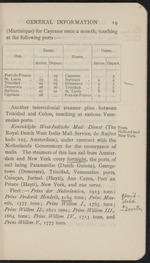 |
“...GENERAL INFORMATION 19
(Martinique) for Cayenne once a month, touching
at the following ports :—
Out. Dates. j Dates.
Arrive. Depart. 1 Arrive. Depart. ]
F ort-de-Fran ce 23 Cayenne 3
St. Lucia 23 23 , I Surinam 4 4 |
Trinidad . 24 24 1 Demerara s 5 1
Demerara 26 26 Trinidad 7 7
Surinam . 27 27 St. Lucia 8 8
Cayenne . 28 ... Fort-de-France 9
Another intercolonial steamer plies between
Trinidad and Colon, touching at various Vene-
zuelan ports.
Koninklijke West-Indische Mail Dienst (The From
Royal Dutch West India Mail Service, de Ruyter Newayorknd
kade 125, Amsterdam), under contract with the
Netherlands Government for the conveyance of
mails. The steamers of this line sail from Amster-
dam and New York every fortnight, the ports of
call being Paramaribo (Dutch Guiana), George-
town (Demerara), Trinidad, Venezuelan ports,
Curasao, Jacmel (Hayti), Aux Cayes, Port au
Prince (Hayti), New York, and vice versa.
Fleet: — Prins der Nederlanden, 1923 tons;
Prins Frederik Hendrik, 2164 tons;...”
|
|
| 14 |
 |
“...GENERAL INFORMATION
2 I
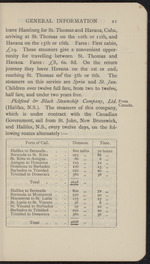
leave Hamburg for St. Thomas and Havana, Cuba,
arriving at St. Thomas on the ioth or nth, and
Havana on the 15 th or 16th. Fares: First cabin,
£19. These steamers give a convenient oppor-
tunity for travelling between St. Thomas and
Havana. Fares: 6s. 8d. On the return
journey they leave Havana on the 1st or 2nd,
reaching St. Thomas on' the 5 th or 6th. The
steamers on this service are Syria and St. Jan.
Children over twelve full fare, from two to twelve,
half fare, and under two years free.
Pickford Ó* Black Steamship Company, Ltd. From
(Halifax, N.S.). The steamers of this company, Canada-
which is under contract with the Canadian
Government, sail from St. John, New Brunswick,
and Halifax, N.S., every twelve days, on the fol-
lowing routes alternately:—
Ports of Call. Distance. Time.
Halifax to Bermuda. 800 miles 72 hours
Bermuda to St. Kitts 925 .» 86 ,,
St. Kitts to Antigua . 60 ,, 6 ,,
Antigua to Dominica 123 ,, 12 1,
Dominica to Barbados 170 ,, IS
Barbados...”
|
|
| 15 |
 |
“...GENERAL INFORMATION
23
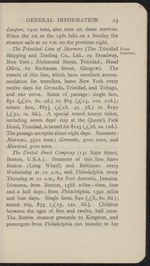
Laupar, 1400 tons, also runs on these services.
When the 1st or the 15th falls on a Sunday the
steamer sails at 10 p.m. on the previous night.
The Trinidad Lint of Steamers (The Trinidad From
Shipping and Trading Co., Ltd., 29 Broadway, Araenca-
New York; Richmond Street, Trinidad; Head
Office, 62 Buchanan Street, Glasgow). The
vessels of this line, which have excellent accom-
modation for travellers, leave New York every
twelve days for Grenada, Trinidad, and Tobago,
and vice versa. Rates of passage: single fare,
$50 G£IO> 8s. 4d.) to I65 (^13, 1 os. rod.);
return fare, $87^ (;£i8, 4s. 7d.) to $250
(^52, is. 8d.). A special round tourist ticket,
including seven days’ stay at the Queen’s Park
Hotel, Trinidad, is issued for $123 (f26, os. iod.).
The passage occupies about eight days. Steamers:
Maracas, 3500 tons; Grenada, 3000 tons, and
Maraval, 3000 tons.
The United Fruit Company (131 State Street,
Boston, U.S.A.). Steamers of this line leave
Boston (Long Wharf) and...”
|
|
| 16 |
 |
“...GENERAL INFORMATION 25
the first port takes about six days, and the length
of time spent at each of the islands about six or
eight hours. After discharging cargo the steamer
usually proceeds to the next port at night, so
that tourists have an opportunity of going ashore
during the daytime. The length of time required
to make the round trip from New York to Deme-
rara and back is almost thirty days, the steamers
calling off the islands on the voyage north in
passing, whether by day or at night, just to pick
up mails and passengers. The rate of passage
from New York to any island is $40 (£8, 6s. 8d.),
%° G£i°> 8s. 4d.), and $55 (^n, 9s. 2d.), accord-,
ing to the accommodation, and to Demerara, $65
(£t-3> ios. rod.). For some special deck cabins
there is an extra charge of $5 {£1, os. rod.).
Return tickets are double the above rates. The
s.s. Trinidad or the s.s. Pretoria sails every three
weeks to Barbados direct, calling at the Islands
to pick up produce on the voyage north. This
is a popular...”
|
|
| 17 |
 |
“...CHAPTER II
GENERAL INFORMATION
(continued)
Outfit—The Voyage—Thé Customs—Telegrams—Postal facili-
ties—Population — Religion—Freemasonry—Language—
The Laundry—Books on the West Indies.
There is no need to buy an elaborate outfit Outfit,
for a visit to the West Indies. It should be ,
borne in mind that the less luggage that is taken Luggage. |
the better it is for the temper. Where much land
travelling is contemplated, substantial leather suit ^
cases and portmanteaux are best. They can be
kept in good condition and insect proof by
periodical applications of brown boot polish. A
capacious canvas sack, with a padlock fastening,
into which surplus effects can be dumped at the
last minute, is the greatest convenience, and a
fold-up cabin “ tidy ” with pouches for the various
articles of toilet is almost indispensable. Should
the steamer be the base of operations of the
tourist, steel or stout leather cabin trunks are
recommended, the most convenient size being
36 ins. long, 20 ins. wide, and...”
|
|
| 18 |
 |
“...GENERAL INFORMATION
29
for long day excursions before dawn, when the 1
temperature is, comparatively speaking, low, a I
loose flannel coat or wrap is indispensable. A
thin silk tea-gown and an ordinary evening dress
should also form part of the outfit. Tourists will
be well advised not to make themselves too con- .
spicuous with puggarees and similar eccentricities, '
as cabmen and boatmen naturally consider those
who do so to be fair game, and deal with them
accordingly. Sun hats are best purchased locally.
Blue spectacles are a comfort in Barbados, where
the glare from the coral roads is very trying.
A waterproof cape will be found convenient,
but in ordering it care should be taken to mention
that it is for use in the tropics, as beetles have
a predilection for inferior caoutchouc. Kid and
patent leather should be avoided for foot wear
for the same reason. Deck chairs can nowadays Deck
generally be hired aboard the steamers (R.M.S.P. Chairs>
Co., 4s.), but to ensure complete comfort...”
|
|
| 19 |
 |
“...GENERAL INFORMATION
3i
are aboard, and the steamer is slipping down
Southampton Water, passing Netley on the left,
or the port side, as it should now be called. On
turning into the Solent, Cowes is seen, and then
in succession Yarmouth, Totlands Bay, Alum Bay,
and the Needles to the left, with Hurst Castle
standing out on a spit of sand to the right.
The pilot is dropped off the Needles, and the
steamer proceeds to Cherbourg, where passengers
are embarked that evening, and thence, under the
present arrangements, to Vigo, whose magnificent Vigo,
bay has been the scene of many naval engage-
ments. The town was assaulted and burnt by the
English under Drake and Norris in 1589; and,
on October 22, 1702, the combined English and
Dutch fleets attacked the French and Spanish
in the port. Several men-of-war and galleons
were taken and many destroyed, and an abund-
ance of plate and other valuable effects fell into
the hands of the conquerors. Vigo was taken
by Lord Cobham in 1719, but relinquished...”
|
|
| 20 |
 |
“...GENERAL INFORMATION
33
“ I have fought for Queen and Faith like a valiant
man and true; . . .
With a joyful spirit I Sir Richard Grenville die.”
After passing the Azores, awnings are put out,
md the first touch of the tropics begins to make
itself felt; cooler garments are donned, and the
officers of the ship appear in white suits. Soon
the Sargasso Sea is entered, and tourists will note, The
probably for the first time, the remarkable Gulf l^8*80
weed, which floats in a vast eddy or central pool
of the Atlantic between the Gulf Stream and the
Equatorial current. It was on entering this sea
that the crew of Columbus’ ship very nearly
mutinied, believing as they did that their vessels
had reached land, and were on the verge of
running on the rocks, though really the ocean
is here fully four miles deep. The origin of this
mass of weed is not known, but it presumably
was once attached to rocks, though it is now
propagated as it floats on the surface. In colour,
it is yellow, and it supports...”
|
|