| 1 |
 |
“...CONTENTS
CHAPTER PAGE
I. General Information. . . . i
II. More General Information . . 15
III. The Bermudas . . . . , 43
IV. The Bahamas . . . 63
V. Barbados..........................74
VI. Trinidad and Tobago . . . 113
VII. The Windward Islands . .. . 153
VIII. The Leeward Islands . . . 199
IX. Jamaica and its Dependencies . . 255
X. The French West Indies . . . 305
XI. The Virgin Islands of the United
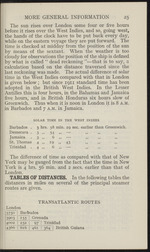
States..........................321
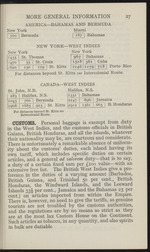
XII. Porto Rico.......................332
XIII. The Dutch West Indies . . . 339
XIV. Cuba ....... 344
XV. Haiti and Santo Domingo . . . 365
XVI. British Guiana and British Honduras 371
XVII. The Spanish Main ... . 400
XVIII. The Panama Canal . ; 417
XIX. Some West Indian Industries . . 434
XX. Concluding Remarks .... 448
APPENDIX
I. Steamship Communication . . . 452
II. Dollars and Sterling Tables . . 466
Index . .........................467
ix...”
|
|
| 2 |
 |
“...THE POCKET GUIDE TO THE
WEST INDIES
Chapter I
GENERAL INFORMATION
The West Indies : Their Position and Names : Geology :
Climate : Health : Food and Beverages : Meals : Ex-
penses : Money : Banks : Insurance Policies : Amuse-
ments and Sport: Roads and Motoring.
The West Indies consist of a chain of islands varying
in size from 44,178 square miles, the area of Cuba, to
small islets of only a few acres in extent, which stretch
in a curve from Florida to the northern coast of South
America. Beginning at the north-west with the
Bahamas, they end at the south-east with Trinidad, off
the coast of Venezuela. They owe their name to the
fact that Columbus when he first sighted them believed
that he had reached India by a western route, as he
had for long hoped to do. The name Antilles, which is
also given to the islands, is said to be derived from
Antilla, or Antiglia, a mythical land which was believed
to exist in the west, and is placed on ancient charts
about two hundred leagues to the westward...”
|
|
| 3 |
 |
“...GENERAL INFORMATION 3
as the Caribbean Andes, which at the beginning of the
Tertiary Period formed a connecting link between North
and South America. It is claimed that this has been
proved by the discovery in Georgia and Carolina of the
fossilised remains of animals which still exist in South
America, by the similarity of the tribal habits and
customs of the Indians of Guiana to those of the North
American Indians, and by traces found in Guadeloupe
of the Megatherium, a prehistoric animal which could
never have existed within the narrow limits of a com-
paratively small island. At this period the position of
the present Isthmus of Panama was probably occupied
by a group of islands, of which one at least—now repre-
sented by Ancon Hill, overlooking Panama City—was of
volcanic origin. It is believed that when the Isthmus
of Panama was formed the land was much higher than
it is at present, borings made by the Canal engineers
having shown the existence of old channels of the Rio
Grande and...”
|
|
| 4 |
 |
“...GENERAL INFORMATION 5
suffered from a hurricane in 1899, had previously
enjoyed immunity for upwards of one hundred years.
Volcanic eruptions are fortunately confined to the
Montagne Pelée in Martinique and the Soufrière in
St. Vincent, both of which had been quiescent for very
many years prior to the outburst of 1902, and are now
peacefully sleeping again ; and seismic movements are
generally so slight as to be scarcely noticeable. During
January, February, and March, the north-east trade-
winds blow with great regularity, rendering those
months particularly pleasant, and, speaking generally,
year in and year out, the favourable features of the
West Indian climate far outnumber the bad.
HEALTH. There are well-qualified physicians in
each of the West Indian islands, British Guiana, and
British Honduras, besides efficient Government medical
services. Indeed, throughout the West Indies there is
no lack of medical men; but tourists who adopt the
usual precautions as to diet and mode of living...”
|
|
| 5 |
 |
“...GENERAL INFORMATION 7
mutandis, are claimed for labba and black creek water
in British Guiana, and for pigeon peas in Montserrat.
Conchs are a favourite article of diet in the Bahamas
and the Turks and Caicos Islands. In the Bahamas
they are so plentiful that the people bom there are
nicknamed “ Conchs.” Land-crabs make delicious
eating, but care should be taken to ascertain that they
have been brought up in clean surroundings. In Trini-
dad, Grenada, and Antigua especially, the small oysters
which adhere to the roots of the mangrove trees fonn
a novelty, and should be asked for; while in British
Guiana it would be rank heresy to ignore the famous
“pepper-pot.” The ingredients of this savoury dish
are: Pork cut into small pieces and fried until brown,
a partially roasted fowl also cut up, an onion, a dozen
shallots, and a few dry chillies, stirred well in a large
earthenware pipkin, locally called a buck-pot. To this
is added a sauce consisting of two tablespoonfuls of
moist sugar, one...”
|
|
| 6 |
 |
“...GENERAL INFORMATION 9
comer should guard against the tendency to increase the
quantity consumed which inevitably results from a
rising thermometer. The water in the principal towns
is, as a rule, quite drinkable; but itls bestto beonthe
safe side and to insist upon its being boded or filtered.
This is usually done by means of a Barbados drip-
stone,” a large block of coral rock hollowed into a con-
venient shape through which the water drips into a
receptacle below. Light wines or whisky and soda m
moderation are perhaps the safest drinks m the
tropics; while for abstainers, lemonade, ginger-ale,
kola and similar concoctions can always be obtained;
and lime squashes will be found infinitely preferable to
the more familiar lemon squash. Among other bever-
ages peculiar to the West Indies are pimento dram and
falemum, while the old-time sangaree also has its
devotees. The latter, which is very refreshing, consists
of wine, water (perhaps), sugar, nutmeg, a slice of lime,
and an abundance...”
|
|
| 7 |
 |
“...GENERAL INFORMATION - it
of buggies, horses, motor-cars (in the larger places),
boats, and trains; but the tourist will be on the safe
side if he estimates his expenses on shore at from
£i ios. ($7.20) to £2 ($9.60) a day, without taking
into consideration what he may spend on those
delightful “ curios ” and souvenirs, the purchase of
which for friends at home is one of the pleasures of
travel.
MONEY. Visitors are recommended to carry letters
of credit from their bankers, which will be honoured
throughout the West Indies. British silver is the cur-
rency in the British West Indies; but British and
American gold is negotiable. Gold doubloons—the
old "pieces of eight” of the days of the buccaneers
—were finally withdrawn from circulation all over the
British West Indies in June, 1908. Public accounts are,
as a rule, shown in sterling ; but as banking and private
accounts are mainly kept in dollars and cents, and as
much trading is conducted on this basis, a table for
comparing the relative...”
|
|
| 8 |
 |
“...collection bills of exchange, and conducts general
banking business connected with the West Indies. It
also affords banking facilities between the West Indies
and Canada through its agents in the Dominion, the
Bank of Montreal.
The Bank of Nova Scotia (established 1832. Capital
authorised, $15,000,000; paid up, $10,000,000 ; reserve
fund, $19,500,000. Head office, Halifax, N.S.;
General Manager’s office, Toronto; London office,
108, Old Broad Street, E.C. 2. Branches throughout
Canada and Newfoundland, and in the principal
cities of the United States). Ten branches in Jamaica
(Kingston, Mandeville, Savanna-la-Mar, Black River,
Montego Bay, St. Ann’s Bay, Port Maria, Port Antonio,
Spanish Town, and Morant Bay); eight in Cuba (Cama-
guey, Cienfuegos, Havana—four offices, Manzanillo and
Santiago de Cuba); two in Porto Rico (Fajardo and
San Juan), and three in the Dominican Republic (Santo
Domingo, San Pedro de Macoris, and Santiago de los
Caballeros). A general banking business is done, and
particular...”
|
|
| 9 |
 |
“...GENERAL INFORMATION 13
(Havana), Jamaica (Kingston), and Trinidad (Port of
SPKSURAN0E POLICIES. Intending visitors to the
West Indies whose lives are insured should arrange
for their policies to be made valid outside the United
Kingdom, Canada, or the United States, as the case may
be, if these are not already world-wide.
AMUSEMENTS AND SPORT. There is no lack of
amusements and sport provided for visitors to the West
Indies, and the opportunities for indulging in them are
dealt with under the heading “Sport” in the suc-
ceeding chapters. The favourite games are lawn-tennis,
croquet, golf, and cricket, and, in the islands under
American influence, baseball. There are ample faculties
for bathing and dancing, whilst in comparatively recent
years motoring has added greatly to the pleasures of a
visit to the tropics. Picnics, formerly called maroon
parties ” in the West Indies, are also popular. Fishing,
both in sea and river, and to a lesser extent shooting,
can also be enjoyed.
For filing...”
|
|
| 10 |
 |
“...Chapter II
MORE GENERAL INFORMATION
Steamship Routes : Outfit: The Laundry : Passports :
The Voyage : The Time : Tables of Distances : The
Customs : Books : Telegraphic Communication : Postal
Services: Population: Religion: Freemasonry:
Language.
STEAMSHIP ROUTES. A list of Steamship Com-
panies whose steamers touch at West Indian ports will
be found in Appendix I. The facilities for reaching
the West Indies, whether from the United Kingdom,
Europe, Canada, the United States, or South America,
are good, and there are more or less frequent oppor-
tunities for getting from island to island by steamer,
sloop, or schooner. Unless compelled to do so by the
stress of circumstances, tourists will do well to avoid
the two last-named means of communication, which are
uncertain, and often involve considerable discomfort.
As a general rule, the only sleeping accommodation on
such vessels is in what is called a “ dog hutch,” a sort
of elongated chicken-coop chained to the deck, and
generally infested...”
|
|
| 11 |
 |
“...MORE GENERAL INFORMATION 17
Ladies should take their usual thin summer dresses,
but shun openwork blouses, which are a source of great
attraction to mosquitoes, and, owing to the action of
the sun, give the wearer the appearance of being tattooed
when she appears in evening dress. Dresses and parasols
made of glacé silk, chiffon, or taffeta should also be left
at home, as they suffer in the tropics. So, too, should
sequin dresses, as the sequins yield to the great heat and
become unpleasantly sticky. Articles of pongee or of
soft washing silk are, on the other hand, recommended.
A light dinner-gown and one or more ordinary evening
dresses should form part of the outfit. Wool or silk
should always be worn next the skin. Silk stockings
are preferable to cotton, and two pairs of the former
worn at the same time are said to be impervious to
mosquitoes. Light wraps should be provided as pro-
tection against chills in the evenings and heavier ones
for travel by sea. For night attire, a material...”
|
|
| 12 |
 |
“...MORE GENERAL INFORMATION
19
I Though passports are no longer required everywhere in
I the West Indies, the adoption of this course may save
much irritation and inconvenience during the voyage.
THE VOYAGE. The delights of a sea voyage have
I often been described, and no visitor to the Caribbean
■who commits his impressions to paper on his return
■ fail? to expatiate regarding the familiar scenes and
■amusements on ship-board, such as the daily “ sweep ”
Ion the run of the ship, the parade of the crew on Sunday,
■ the fiddles on the tables in rough weather, leading in-
ievitably to reference to the concerts, the fancy balls,
land so on, which make the fortnight between England
land Barbados, and between Avonmouth and Jamaica,
land the shorter journeys between Canada and the
■United States and the West Indies pass so pleasantly
! for the traveller who takes Kingsley’s advice, and in
■respect of his fellow:passengers is
"To their faults a little blind ;
And to their virtues very kind.
I, Two...”
|
|
| 13 |
 |
“...MORE GENERAL INFORMATION
21
I to the summit of the crater (donkeys can be hired). Also
\ to Povocao, whence the ascent to Furnas can be made
i by carriage or donkey in about two hours.
The best hotels in Ponta Delgada are Brown’s Hotel,
i at the back of the town, and Acoriano Hotel, near the
ilanding-stage.
After passing the Azores, awnings are put out, and the
I first touch of the tropics begins to make itself felt; cooler
igarments are donned, and the officers of the ship appear
| in white suits. Soon the Sargasso Sea is entered, and
(tourists will note, probably for the first time, the remark-
: able Gulf weed, which floats in a vast eddy or central pool
| of the Atlantic between the Gulf Stream and the equatorial
■current. It was on entering this sea that the crew of
■Columbus’ ships very nearly mutinied, believing that the
(vessels had reached land, and were on the verge of run-
t ning on the rocks, though really the ocean is here fully
four miles deep. The origin of the weed is not...”
|
|
| 14 |
 |
“...MORE GENERAL INFORMATION 23
knots and read of the discomforts with which their for-
bears had to put up. Jeaffreson took leave of his friends
at Billingsgate, was rowed down to Gravesend on
February 16th, 1675-6, and went aboard the “ Jacob
and Mary, a vessell of about a hundred and fifty tunns,
14 or 16 gunns, and a square steame.” This was on
Thursday, and on Sunday she anchored in the Downs,
“ where we went ashoar; but the wind in two or three
dayes promessing faire,” she proceeded on her way,
only to put in at Plymouth on the following Saturday,
the 26th, “ the windes being contrary,” and compelling
her to ride at anchor for “ tenne dayes.” On March 6th,
“ the winde comeing about to the north-east,” she
“ again hoisted sayle and stood out to sea. . . . The
tenth day .it blew hard which made a verry rough and
hollow sea, which raked us fore and aft, breaking some-
tymes over our quarter; in which great seas, our shipp’s
crew concluded, that our little leakie companion ” (a
small vessel...”
|
|
| 15 |
 |
“...MORE GENERAL INFORMATION 25
The sun rises over London some four or five hours
before it rises over the West Indies, and so, going west,
the hands of the clock have to be put back every day,
while on the eastern voyage they are put forward. The
time is checked at midday from the position of the sun
by means of the sextant. When the weather is too
cloudy for observations the position of the ship is defined
by what is called “ dead reckoning ”—that is to say, a
calculation based on the distance traversed since the
last reckoning was made. The actual difference of solar
time in the West Indies compared with that in London
is given below ; but since 1911 standard time has been
adopted in the British West Indies. In the Lesser
Antilles this is four hours, in the Bahamas and Jamaica
five hours, and in British Honduras six hours slow of
Greenwich. Thus when it is noon in London it is 8 a.m.
in Barbados and 7 A.M. in Jamaica.
SOLAR TIME IN THE WEST INDIES
Barbados .
Demerara .
Jamaica
St. Thomas...”
|
|
| 16 |
 |
“...MORE GENERAL INFORMATION 27
AMERICA—BAHAMAS AND BERMUDA
New York Miami
J 700 I Bermuda | 187 | Bahamas
New York
NEW YORK—WEST INDIES
New York
Bahamas
Cuba
1435 St. Thomas 967 1528 2246
'*'479 35 St. Croix
£020 150 119 | St. Kitts
1279
718 I Porto Rico
For distances beyond St. Kitts see Intercolonial Route.
St. John, N.B.
CANADA—WEST INDIES
Halifax, N.S.
Bahamas
Jamaica
665" “
283 Halifax, N.S. 135*
1043 760 Bermuda 2247
1968 1685 925 | St. Kitts 2912
896
1561
B. Honduras
For distances beyond St. Kitts see
Intercolonial Route.
CUSTOMS. Personal baggage is exempt from duty
in the West Indies, and the customs officials in British
Guiana, British Honduras, and all the islands, whatever
their nationality may be, are courteous and considerate.
There is unfortunately a remarkable absence of uniform-
ity about the customs’ duties, each island having its
own tariff, which includes specific duties on certain
articles, and a general ad valorem duty—that is to say,
a duty of a certain fixed sum...”
|
|
| 17 |
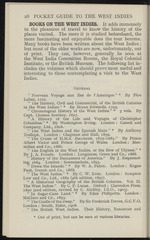 |
“...of the
places visited. The more it is studied beforehand, the
more fascinating and enjoyable does the tom: become.
Many books have been written about the West Indies;
but most of the older works are now, unfortunately, out
of print. They can, however, generally be seen at
the West India Committee Rooms, the Royal Colonial
Institute, or the British Museum. The following list in-
cludes the volumes which should prove most useful and
interesting to those contemplating a visit to the West
Indies.
General
“ Nouveau Voyage aux lies de 1’Amerique.” * By Père
Labat, 1722.
“ The History, Civil and Commercial, of the British Colonies
in the West Indies.” * By Bryan Edwards, 1793.
" Chronological History of the West Indies." * 3 vols. By
Capt. 'ihomas Southey, 1827.
“ A History of the Life and Voyages of Christopher
Columbus.” * By Washington Irving. London : Cassell and
Company, Ltd., 1828.
" ihe West Indies and the Spanish Main.” * By Anthony
Trollope. London : Chapman and Hall, 1839.
" The Cruise...”
|
|
| 18 |
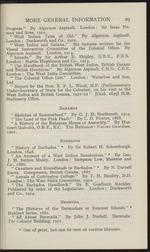 |
“...MORE GENERAL INFORMATION 29
Progress.” By Algernon Aspinall. London: Sir Isaac Pit-
man and Sons, 19x2. . . „
" West Indian Tales of Old.” By Algernon Aspinall.
London : Duckworth and Co., 1912.
" West Indies and Guiana.” Six lectures written for the
Visual Instruction Committee of the Colonial Office. By
Algernon Aspinall. London, 1914.
'* Islands.” By Sir Arthur E. Shipley, G.B.E., F.R.S.
London: Martin Hopkinson and Co., 1924.
“ The Handbook of the British West Indies, British Guiana
and British Honduras.” By Algernon Aspinall, C.M.G., C.B.E.
London : The West India Committee.
" The Colonial Office List.” London: Waterlow and Son,
Ltd. „
•• Report by the Hon. E. F. L. Wood, M.P. (Parliamentary
Under-Secretary of State for the Colonies), on his visit to the
West Indies and British Guiana, 1921-22 ” [Cmd. 1679] H.M.
Stationery Office.
Bahamas
“ Sketches of Summerland.” By G. J. H. Northcroft, 1912.
■* The Land of the Pink Pearl.” By L. D. Powles, 1888.
" A History of the Bahamas House...”
|
|
| 19 |
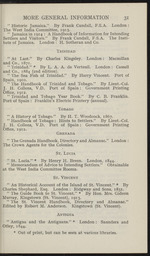 |
“...MORE GENERAL INFORMATION 31
if " Historic Jamaica.” By Frank Cundall, F.S.A. London :
The West India Committee, 1915.
j; " Jamaica in 1924 : A Handbook of Information for Intending
Settlers and Visitors.” By Frank Cundall, F.S.A. The Insti-
tute of Jamaica. London : H. Sotheran and Co.
Trinidad
1 " At Last." By Charles Kingsley. London: Macmillan
and Co., 1871.
L " Trinidad." * By L. A. A. de Verteuil. London : Cassell
and Co., 1884 (2nd edition).
" The Sea Fish of Trinidad.” By Harry Vincent. Port of
I Spain, 1910.
" The Handbook of Trinidad and Tobago.” By Lieut.-Col.
J. H. Collens, V.D. Port of Spain: Government Printing
Office, 1912.
I " Trinidad and Tobago Year Book.” By C. B. Franklin.
Port of Spain : Franklin’s Electric Printery (annual).
Tobago
"A History of Tobago.” By H. T. Woodcock, 1867.
" Handbook of Tobago : Hints to Settlers.” By Lieut.-Col.
J. H. Collens, V.D. Port of Spain: Government Printing
I Office, 1912.
Grenada
" The Grenada Handbook, Directory and Almanac.” London...”
|
|
| 20 |
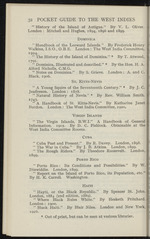 |
“...T. Atwood,
1791.
' “ Dominica, Illustrated and described.” * By the Hon. H. A.
Alford Nicholls, C.M.G.
“ Notes on Dominica.” By S. Grieve. London : A. and C.
Black, 1906. . '
St. Kitts-Nevis
" A Young Squire of the Seventeenth Century." * By J. C.
Jeaffreson. London: 1878.
" Natural History of Nevis.” * By Rev. William Smith.
*745-
“ A Handbook of St. Kitts-Nevis.” By Katharine Janet
Burdon. London : The West India Committee, 1920.
Virgin Islands
** The Virgin Islands, B.W.I.” A Handbook of General
Information. 1912. By D. C. Fishlock. Obtainable at the
West India Committee Rooms.
Cuba
" Cuba Past and Present.” By R. Davey. London, 1898.
“ The War in Cuba.” By J. B. Atkins. London, 1899.
" The Rough Riders.” By Theodore Roosevelt. London,
1899- . I
Porto Rico
“ Porto Rico: Its Conditions and Possibilities.” By W.
Dinwiddie. London, 1899.
“ Report on the Island of Porto Rico, its Population, etc.”
By H. K. Carroll. Washington.
Haiti j
" Hayti, or the Black Republic.” By Spencer St. John...”
|
|