| 1 |
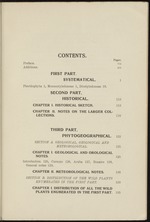 |
“...CONTENTS
Pages.
Preface. vn
Additions. xn
FIRST PART.
SYSTEMATICAL. 1
Pteridophyta 1, Monocotyledöneae 1,. Dicotyledoneae 19.
SECOND PART.
HISTORICAL. ns
CHAPTER I. HISTORICAL SKETCH. 113
CHAPTER II. NOTES ON THE LARGER COL-
LECTIONS. 116
THIRD PART.
PHYTOGEOGRAPHICAL. 123
SECTION A. OROLOGICAL, GEOLOGICAL AND
METEOROLOGICAL. 125
CHAPTER I. GEOLOGICAL AND OROLOGICAL
NOTES. 125
Introduction 125, Curasao 126, Aruba 127, Bonaire 128,
General notes 129.
CHAPTER II. METEOROLOGICAL NOTES. 130
SECTION B. DISTRIBUTION OF THE WILD PLANTS
ENUMERATED IN THE FIRST PART. 133
CHAPTER I. DISTRIBUTION OF ALL THE WILD
PLANTS ENUMERATED IN THE FIRST PART. 135...”
|
|
| 2 |
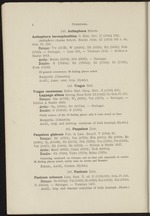 |
“...4
Gramineae.
140. Anthephora Schreb.
Anthephora hermaphoditica 0. Ktze. Rev. II (1891) 759;
Anthephora elegans Schreb. Beschr. Gras. Ill (1810) 105 t. 44;
Gris. FI. 556.
Curasao: Vw (4713); W (49265); Hk (5320); Kit (5500); Huk
(5569). — Suringar, — Lens 828, — Versluys 1412,' — Britton &
Shafer 2918.
Aruba: Mankz (6278); Siw (6329). — Suringar.
Bonaire: R (7025e); Rk (7095a); Rt (7154); Rt (7159);
Krak (7445).
Of general occurrence; 30 finding places noted.
Margarita. (Johnston).
Antill., Amer. cont. trop. (Symb.).
143. Tragus Hall.
Tragus racemosus Haller Hist. Stirp. Helv. II (1768) 203;
Lappago aliena Spreng. Neue Entd. III (1822) 15; Gris FI. 557.
Curasao: Cas (4790); W2 (5065); Yat (5372). - Suringar, —
Britton & Shafer 2960.
Aruba: Ok2 (6236); Siv (6313a). — Suringar.
Bonaire: R (70255); R (7380).
Pretty scarce; of the 18 finding places only 5 were noted on lime.
Margarita. (Johnston).
Antill., trop. and subtrop. countries of both hemisph. (Symb.).
161. Paspalum Linn.
Paspalum glabrum...”
|
|
| 3 |
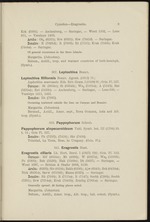 |
“...Cynodon—Eragrostis. 9
Krk (5591). — Aschenberg, — Suringar, — Went 1102, — Lens
811, — Yersluys 1403.
Aruba: Ok2 (6231); Siw (6331); Siw (7342d). — Suringar.
Bonaire: R (7025d); R (7059); Rt (7151); Krak (7443); Krak
(7444a). — Suringar.
Of general occurrence in the three islands.
Margarita. (Johnston).
Baham., Antill., trop. and warmer countries of both hemisph.
(Symb.).
307. Leptochloa Beauv.
Leptochloa filiformis Beauv. Agrost. (1812) 71;
Leplochloa mucronata Kth. Rév. Gram. I (1829) 91; Gris. F|. 537.
Curasao: St (5054v); St (5054h); Wa3 (5101a); A (5145); Bat
(5232a); Ent (5433c). — Aschenberg, — Suringar, — Lens 830, —
Yersluys 1411, 1421.
Bonaire: Rh (7035).
Occurring scattered outside the lime on Curasao and Bonaire.
Margarita. (Johnston).
Bermud., Antill., Amer. sept., Nova Granata, Asia and Afr.
trop. (Symb.).
310. Pappophorum Schreb.
Pappophorutn alopecuroideum Vahl. Symb. bot. Ill (1794) 10.
t. 51; Gris FI. 537.
Bonaire: Fh (7253); (7424); Skr (7438).
Trinidad, La Tinta, Bras...”
|
|
| 4 |
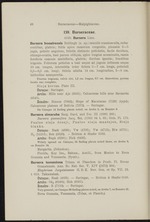 |
“...spread on Curacao, 34 finding places noted there, on Aruba 9,
on Bonaire 14.
Margarita. (Johnston).
Florida, Key Ins., Baham., Antill., from Mexico to Nova
Granata and Venezuela. (Symb.).
Bursera tomentosa Triana et Planchon in Prodr. FI. Novae
Granatensis. Ann. Sc. Nat. Ser. V. XIV (1872) 304;
Elaphrium Jacquinianum H. B. K. Nov. Gen. et Sp. VII. 23.
t 613. Takamahak.
Curasao; Nask (4695). — Suringar, — Britton & Shafer 3146.
Aruba: Ok2 (6240); Hoh (6367).
Bonaire: R (7110). — Suringar.
Very general; on Curacao 36 finding places noted, on Aruba 7, on Bonaire 16.
Nova Granata, Venezuela. (Trian. et Planch.)....”
|
|
| 5 |
 |
“...PHYTOGEOGRAPHICAL
A. Orological, Geological and
Meteorological
CHAPTER I
GEOLOGICAL AND OROLOGICAL NOTES.
Introduction.
When preparing my journey to the three Leeward Islands I could
only avail myself of the Geological and Orological data from
K. Martin, Bericht fiber eine Reise nach Niederiandisch West
Indien, Leiden 1887.
At the time of my visit the Government was carrying out trian-
gulations on the three islands and also preparing a topographical
map of Curagao.
Besides a general sketch-map of the roads on Curagao, given me
by Mr. Zelle, Head of the Public Works Department there, and
a sketch-map of a part of Aruba, given me by Mr. R. J. Beaujon,
I had no means of orientation in the three islands.
The lack of maps made itself still seriously felt in 1910 (i. e. 23
years after the publication of Martin’s book); hence my topogra-
phical determinations are mostly based on local information.
During the preparation of this flora the Topographical map of
Curagao, on a scale 1/200.000 has...”
|
|
| 6 |
 |
“...Long,
and 12° 3' N. Lat.; the greatest length of the island is 58 kilo-
metres, its surface + 450 square kilometres.
The long-drawn island is a hilly country, the hills consisting of
diabase or being of cretaceous origin, the whole being surrounded
by a layer of a coral-limestone formation. On the narrower
part of the island the nothern and southern coral-limestone
masses join and reach there the considerable height of 90 M.
The inland hills are in East Curagao lower than in the West and
give a general impression of a low undulating hilly country; the
tops are not much higher there than 60 M., as a rule; the high
top nearer the North side (Ronde klip) is the only inland hill
which is covered with a coral mass. It is 130 M. high,
The calcareous territory of East Curagao reaches a height of 60 M.
in some places of the North coast, on the South coast it is much
lower and only in the Tafelberg (St. Barbara) reaches a height
of 200 M. This Mount Barbara with its gentle slope towards the
sea and...”
|
|
| 7 |
 |
“...highest top in the Brandaris, 240 M.
From this mountain and the Karakao, 158 M., situated a little
more to the N. E., two mountainranges proceed in a S. E. direc-
tion, consisting of round cup-shaped hills with a few apices and
ending in the Joewa and Makakoe.
Besides the large valley of Rincon, bordered to the West by the
Brandaris complex, to the South by the high chalk ridge and to
the North by the lower chalk ridge we find in East Bonaire a
large plain, extending from Karakao to the coast.
General notes.
On account of the occurrence of eruptive rocks in the islands
Curasao, Aruba and Bonaire Sieversx) is of opinion that these
islands must be considered to form one complex with Goajira,
which in its turn would cohere with the Sierra Neveda de Santa
Martha and extend over the first mentioned islands as far as Los
Rocques. When discussing the vegetation we shall see that a few
plants occurring in Santa Martha are found in the three islands,
forming the subject of this Flora. It should be...”
|
|
| 8 |
 |
“...CHAPTER I
NOTES ON THE ASPECT OF THE VEGETATION OF
CURACAO, ARUBA AND BONAIRE.
The general impression of the vegetation of the islands Curagao,
Aruba and Bonaire is that of a dry country, where thorny shrubs
and cactuses predominate and more or less compete with each
other.
When, e.g. on Bonaire we climb one of the hills of the Western
part, wè see there in their purest, intact condition the pretty
thick bushes of shrubs, from which tree-shaped Cereus species
rise to a great height.
Since everywhere in the three islands a strong N.E. monsoon
blows incessantly, the climate is rather dry and there is generally
not much variation between high and low, also the vegetation has
everywhere a rather uniform aspect.
Excepting a few less exposed parts and the higher tops of Curagao
and Bonaire, the whole vegetation may be said to have a more
or less xerophile character; in many places where the soil is covered
bij hardly any humus, as on the numerous limestone table lands,
it becomes a very poor...”
|
|
| 9 |
 |
“...description. On the Leeward still more than on
the Windward Islands this type of vegetation cannot be distinctly
separated from the litoral vegetation which only near the salt-pans
assumes a character of its own by the occurence of Mangrove
plants.
In many parts of the Islands culture or traces of former culture
are found; also ruderal plants are found everywhere, among which
a large number of tropical cosmopolitans. A genuine original
vegetation is only found in" the higher parts.
We saw that in general there is some difference in the vegetation,
depending on shrubs or herbs being more prominent; a division
according to the occurrence or non-occurrence on calcareous soil and
a characterisation of these vegetation types is possible in exceptional
cases only. So we do not or hardly ever find on calcareous soil:
Panicum velutinosum,
Pisonia bonairensis,
Capparis Breynia,
Capparis linearis,
Trichilia trifolia,
Spondias Mombin.
On the other hand we always or nearly always find on lime:
Sesuvium ...”
|
|
| 10 |
 |
“...a few cases and exactly
by the last named plants, when these occur in large quantities,
we can settle whether a caleareous or a non-caleareous vegetation
is present.
A& the result of these observations we have: . .
A litoral vegetation, difficult to separate from the principal
form the Croton-vegetation; this latter is determined by Acacia
and Croton and has either a Capparis type op a Rhacoma-Antirrhoea
type. In the higher parts this Croton-vegetation changes into a
more forestlike type; in general the predominant Cactuses are
found in the lower parts, although on Bonaire also some hills
are covered with them. The characteristic Rhacoma type is entirely
■ absent on Aruba, as this plant does not occur there.
The vegetation on Aruba receives a peculiar aspect through
Pithecolobium platylobum, which occurs there in very large numbers,
especially in the mountainous part, while on Curasao and Bonaire
Randia aculèata forms a very important constituent of the vege-
tation. : . . , _ „„ .
Acacia...”
|
|
| 11 |
 |
“...153
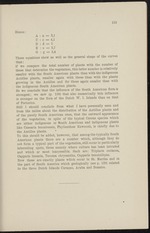
Hence:
A : a = 3,1
C : c = 4,1
D : d = 5
E : e = 3,7
G : g = 2,4
These equations show as well as the general shape of the curves
that: '.
if we compare the total number of plants with the number ot
those that determine the vegetation, this latter number is relatively
smaller with the South American plants than with the indigenous
Antilles plants, smaller again with these than with the plants
growing in the Antilles and for these again smaller than with
the indigenous South American plants.
So we conclude that the influence of the South American flora is
strongest; we saw (p. 139) that also numerically this influence
is stronger on the flora of the Dutch W. I. Islands than on that
of Portorico.
Still I should conclude from what I have personally seen and
from the tables about the distribution of the Antilles plants and
of the purely South American ones, that the outward appearance
of the vegetation, in spite of the typical Cereus. species which
are either indigenous or South American...”
|
|
| 12 |
 |
“...coriaria, Haematoxylon Brasiletto,
Bursera simaruba are the principal constituents of the pretty
dense thickets of shrubs, with Euphorbia thymifolia and especially
Capraria biflora at the bottom. .
Nearer the sea, somewhat lower on the incline, Lantana mvolu-
crata, Bumelia obovata and Croton vegetation become prominent
and finally Agave vivipara with Cactaceae.
Especially in the part West of St. Martha the lime hills are
highly overgrown and treelike forms become more prominent.
Similar in its general character to the above mentioned lime
hills, but in its details somewhat different is the plant-growth on e
Kabrietenberg near Beekenburg.
Climbing this fairly high lime hill from-the land-side we meet
again the rather dense shrubs, among which we notice Malvastrum
spicatum, Melochia tomentosa, Sida, Croton flavens, Cordia cylm-
drostachya, Lantana camara; a very dense shrub-growth compared
with the much more scantily overgrown parts of Curasao. Beurena
succulenta and Acacia tortuosa rise above...”
|
|
| 13 |
 |
“...161
Bonaire.
For a description of the vegetation of the lower lime regions on
Bonaire I choose:
The country round Kralendijk.
Many ruderal plants grow here, e. g. Parthenium Hysterophorus.
The general impression is that of a poor Croton vegetation, con-
sisting of Acacia tortuosa, Prosopis juliflora, Croton flavens, a
few Crescentia Cujete, Bursera simaruba, Cordia alba and Caesal-
pinia coriaria; the ground is covered with Elytraria squamosa,
Sida, Chloris, Dactyloctenium aegyptium, Eragrostis ciliaris, Sporo-
bolus argutus, Anthephora hermaphroditica, Eragrostis Urbaniana.
A vegetation somewhat similar to this, but without ruderal plants
we find in
The district near the Southern salt pans.
Near the sea we see Conocarpus erecta, Avicennia nitida, Suriana
maritima and besides Salicornia ambigua and Sesuvium portula-
castrum; in other , places we find whole masses of Metopium Brow-
nei, whose appearance reminds one of Hippomane bushes. At a
greater distance from the sea the Croton vegetation...”
|
|