| 1 |
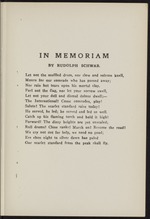 |
“...IN MEMORIAM
BY RUDOLPH SCHWAB.
Let not the muffled drum, nor slow and solemn knell.
Mourn for our comrade who has passed away;
Nor rain hot tears upon his mortal clay.
Furl not the flag, nor let your sorrow swell,
Let not your dull and dismal dolour dwell;
The International I Come comrades, play!
Salute! The scarlet standard raise today!
He served, he led; he served and led us well.
Catch up his flaming torch and hold it high!
Forward! The dizzy heights are yet unsealed;
Roll drums! Close ranks! March on! Resume the road!
We cry not out for help, we need no goad;
Ere ebon night to silver dawn has paled
Our scarlet standard from the peak shall fly....”
|
|
| 2 |
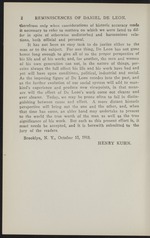 |
“...2 REMINISCENCES OF DANIEL DE LEON.
therefrom only when considerations of historic accuracy made
it necessary to refer to matters on which we were fated to dif-
fer in spite of otherwise undisturbed and harmonious rela-
tions, both official and personal.
It has not been an easy task to do justice either to the
man or to the subject. For one thing, De Leon has not gone
hence long enough to give all of us the proper perspective of
his life and of his work; and, for another, the men and women
of his own generation can not, in the nature of things, per-
ceive always the full effect his life and his work have had and
yet will have upon conditions, political, industrial and social.
As the imposing figure of De Leon recedes into the past, and
as the further evolution of our social system will add to man-
kinds experience and produce new viewpoints, in that meas-
ure will the effect of De Leons work come out clearer and
ever clearer. Today, we may be prone often to fail in...”
|
|
| 3 |
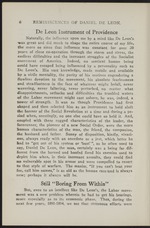 |
“... then selected him as an instrument to hold aloft
Ac banner of the Social Revolution at a time and during a pe-
nod when, seemingly, no one else could have so held it. And,
oupled with these rugged characteristics of the leader, the
forerunner, the pioneer of a new Social Order, were the more
kozaan characteristics of the man, the friend, the companion,
lite husband and father. Sunny of disposition, kindly, vivaci-
wts, always ready with an anecdote or a jest, which latter he
lad to get out of his system or bust as he often used to
say, Daniel De Leon, the man, certainly was a being far dif-
ferent from the horned and hoofed fiend his enemies used to
depict him when, in their incessant assaults, they could find
ao vulnerable spot in his armor and were compelled to resort
to that style of warfare. The maxim, If you cant beat your
foe, call him names, is as old as the human race rand is always
new; perhaps it always will be.
Still Boring From Within*
But, even to an...”
|
|
| 4 |
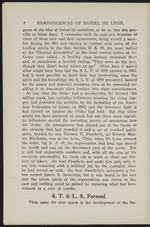 |
“... influences, scenting the rising dan-
ger, had provided the antidote by the formation of the Amer-
ican Federation of Labor, in 1881, and the incessant fight it
had carried on against the Order had told. But that alone
would not have mattered so much had not these same capital-
ist influences carried the corroding poison of corruption into
the Order. Its management had slipped out of the hands of
the element that had founded it and a set of crooked politi-
cians, headed by one Terence V. Powderly, as General Mas-
ter Workman, was at the helm. Thus, when De Leon entered
the order, via D. A. 49, the organization had long ago passed
its zenith and was on the downward part of the curve. But
it still had respectable numbers and, with all the vim of his
energetic personality, De Leon set to work to clean out that
nest of fakers. He beat Powderly and made him quit, only to
see him rewarded with a political job by the capitalist clas.s
he had served so well. He beat Powderlys successor...”
|
|
| 5 |
 |
“...10 REMINISCENCES OF DANIEL DE LEON.
imposes upon men who have to stand in the breach, so to
speak. These two of the tri-partite team succumbed; the
third, De Leon, like a rock jutting out into a raging sea,
breasted the dash of the angry waves until the grim reaper,
death, laid low the mortal part of him; his other part, that
which in the language of Sam French can not, will trot and
did not die, is immortal and will be with us as a living force
as long as the struggle for human emancipation will go on, is
influencing our thought and action today and will continue to
influence countless other human beings yet unborn.
Factors Three
Returning from this digression to the subject in hand, and
taking up again the thread of the narrative when the Socialist
Trade and Labor Alliance was about to be formed, several fac-
tors must now be borne in mind. One is that the backbone of
the new organization was D. A. 49, K. of L. This District
Assembly pulled away from the rapidly...”
|
|
| 6 |
 |
“...12 REMINISCENCES OF DANIEL DE LEON.
York C. I. U., the United Hebrew Trades, located in old New
York, and a small central body in Newark, N. J., but these
did not materially affect the general situation here depicted,
neither of them being factors in the sense described. The
Brooklyn and the Newark bodies were composed of the same
elements as was the New York C. L. F. and ran in the same
rut in a different locality. The U. H. T., on the other hand,
was not strong enough in those days greatly to affect the
complexion of the Alliance as a whole. Immediately
upon the formation of the S. T. & L. A., opposi-
tion began to raise its head, at first rather unde-
fined and impalpable, but taking shape and coming out
into the open after the national convention of the S. L. P.,
held in 1896, had endorsed the S. T. & L. A. What is here
rapidly sketched embodied, of course, an enormous amount
of work of which De Leon had an ample share. He was in-
defatigable, speaking, lecturing...”
|
|
| 7 |
 |
“...REMINISCENCES OF DANIEL DE LEON.
lion. The People had become a paper admired, respected
and feared by such as had reasons to fear it. De Leon knew
the American labor faker to be one of the most serious ob-
stacles in the path of the revolutionary Socialist movement
and he dealt with him accordingly, camping on his trail, ex-
posing his crooked capitalist connections and thus conveying
to the duped rank and file the needed warning. The capital-
ist atmosphere in the United States, productive of rich pick-
ings in politics and in industry, breeds the labor faker as a
swamp will breed mosquitoes. During an election campaign,
the capitalist politician will shell out in exchange for labor
organization endorsements even if he knows them to be
worthless as vote producers, while on the industrial field
strikes may be threatened, may be called and may be settled;
labels and union stamps may be granted and may be with-
held, all of which furnishes endless opportunities for the...”
|
|
| 8 |
 |
“...14 REMINISCENCES OF DANIEL DE LEON.
lectures delivered by him in New York, one that no serious
student of the American Labor movement should be with-
out and, indeed, should know by heart.
S. L. P. Endorses S. T. & L. A.
Under such conditions did the S. L. P. enter upon its
ninth national convention of 1896. That convention marked
another milestone in the Partys development towards an ever
clearer perception of its true mission in the Labor move-
ment of this country. Having grown to a state of maturity,
it took a step which, in 1893, would have been impossible.
The newly-founded Socialist Trade and Labor Alliance was en-
dorsed with the clear understanding of what this step im-
plied; that it meant a declaration of war against the "pure
and simple trades unions of the land, typified by the Amer-
ican Federation of Labor, the erstwhile powerful Knights of
Labor having in the meantime almost vanished from the
field. At the convention, the subject was introduced by Vogt...”
|
|
| 9 |
 |
“...REMINISCENCES OF DANIEL DE LEON. 15
delegate not voting. It is interesting to note that even such
a dyed-in-the-wool labor skate as one G. A. Hoehn, of St.
Louis, caved in and voted in favor of taking that revolution-
ary step forward, though, no doubt, never for a moment in-
tending to live up to his vote. But for all that it had been a
battle royal, the speeches made setting forth clearly the new
road the Party was to journey on. Sanial and Vogt took a
very prominent part in that debate and De Leons effort,
closing the same, was particularly brilliant.
Gold and Silver in 1896
The political situation of that day was interesting and
was also decidedly hot. The capitalist forces had, at the out-
set of the Presidential campaign, divided along the line of the
creditor and debtor divisions of capitalist interests, the for-
mer waving the full dinner-pail, while the latter allegedly-
objected to the crucifixion of mankind "on a cross of gold.
The Republicans, headed by...”
|
|
| 10 |
 |
“... who had engineered that soit
of thing, the fight was carried into the national convention
of the S. T. & L. A. held, in 1898, at Buffalo, N. Y. Both De
Leon and I were delegates. To have some sort of counter-
weight against De Leon who, as the fakers well knew, was
after their scalps, they had secured Thomas J. Morgan, of
Chicago, a man who had evoluted from a machinist into a
lawyer, a rather queer personality, as vain as a peacock and
known all over the country as Tommy I. I. I. Morgan, which
modification of his name he had earned by the constant re-
iteration in his speeches of the personal pronoun, first per-
son, singular. He had some reputation as a speaker and
writer and had acquired further fame as the introducer of the
famous "Plank 10," embodied in the program of the A. F. of
L. at the Detroit convention, utterly disregarded by the of-
ficialdom of the organization and then knocked out at the
next convention, at Denver, Col. Morgan was a Socialist
"too." His...”
|
|
| 11 |
 |
“... interesting polemic ensued. The Volkszeitung, anxious
to raise dust to obscure the real issue, had injacted into the
controversy a side issue, namely, the question of "taxation,
claiming that the working class is made to pay taxes out of...”
|
|
| 12 |
 |
“...20 REMINISCENCES OF DANIEL DE LEON.
finally caused the National Executive Committee of the Party
to submit to the membership, for a general vote, the questionr
Shall the Party sever all connections between it and the So-
cialistic Co-operative Publishing Association; continue, through
its National Executive Committee, the publication of its or-
gans, The People and Vorwaerts, and demand from the said
Association the unconditional surrender of all property be-
longing to the said organs, including their respective mailing
lists and the amount of subscriptions paid in advance?
The Volkszeitung was now at the parting of the ways
Repudiation by the Party was staring it in the face and the
situation, from its point of view, was growing desperate. At
the very outset there was no doubt how that vote would g
and, as returns began to come in, speculation as to the out-
come became certainty. The aforesaid call for the genera!
vote, accompanied by a statement that set forth the...”
|
|
| 13 |
 |
“...
we had been assailed and he demanded that the invaders be
thrown out. They were thrown out.
Cleansed Party Wins Legal Battle
The abortive coup de main at once cleansed the Party in
New York of the disloyal element. Having come out in the...”
|
|
| 14 |
 |
“... in itself.
In this protracted legal battle, the Party finally won out
all along the line. We won out in the injunction case and
did not go to jail though we came very near it at one time,
so near that the Volkszeitung, in a premature but
very triumphant news item, announced that we would
have to go to the lock-up; we won out on the bal-
lot contest and preserved our name and emblem in
New York State; we beat them when they tried to
lay their claws on funds that had been gathered by the Party
for a Daily People. No doubt there were powerful influences
at work behind the scenes that favored a different outcome,
but the conspiracys methods had been too raw, its procedure
too illegal, to make possible its being upheld in court with-
out establishing precedents that would, at one time or other,
recoil upon the established political parties of capitalism
whenever they might have a family row.
In the light of subsequent events, it is not without inter-
est to quote an...”
|
|
| 15 |
 |
“...24 REMINISCENCES OF DANIEL DE LEON.
person who penned it, but is also typical of the set of mon-
tal misfits conducting that paper. It is safe to assume that
even at this very hour, when event after event the world
over proves the unerring foresight of De Leon, as well as the
immense value of his teachings; when it is clearly seen by
millions of men and women, who never heard of De Leon,
that the foundation that he sought to place the revolution-
ary Socialist movement on is the only safe and feasible one,
the only way out, viz., the integral, revolutionary, industrial
organization of the workers of the world, enabling the work-
ing class, everywhere, to take and hold and operate the
means of production and distribution, so that, in time of a
world crisis, when an old social system is seen in the throes
of dissolution and a new order is being born, aye, even in
such an hour would the insect minds of the Volkszeitung
staff in all likelihood again pen the lines penned on...”
|
|
| 16 |
 |
“...REMINISCENCES OF DANIEL DE LEON. 27
Another momentous step, taken by the 1900 convention,
was to insert into the Partys constitution a provision that
No officer of a pure and simple trade or labor organization
shall be a member of a Section. This, too, was an action
that grew directly out of the bitter struggle the Party had
gone through, which struggle dominated the minds of the
membership and created a psychology favorable to the adop-
tion of such a measure. When going over the speeches made
at the convention in support of this measure, one is struck
by the ever recurring note in most of them that it would pro-
tect our membership against pure and simple contamination;
that failure to adopt the measure would make possible their
becoming corrupted by the allurements held out to them when
officers of such organizations, and that this corruption would
then be carried into the Party organization. Viewing this
contention in the light of all that has happened since and in...”
|
|
| 17 |
 |
“... themselves, regarded
the party that ordered it as a hostile force and its members
in their union as instruments of that hostile force. Thus it
meant that our members had to vacate the field and leave the
labor faker in undisputed control. It was he and the S. P.
that would profit.
In the course of time, events proved that we had drawn
the bow too tight and when, some years later, the Party
abandoned that position, the damage had been done and
could not easily be repaired. In all the years De Leon and I
had been working side by side, we had never differed on any
matter of importance until this measure was being agitated
and, much as I respected his foresight and reasoning powers,
I could not be convinced. However, opposition to the meas-
ure amounted to little, the lay of the land being such that it
carried overwhelmingly in the convention and in the subse-
quent general vote of the Party.
The
Troubles and Tribulations
1900 convention having become pa.st history, the
Party...”
|
|
| 18 |
 |
“...32 REMINISCENCES OF DANIEL DE LEON.
arnend the constitution as to abolish the Board of Trustees
form of organization and place the management of the paper
directly into the hands of the N. E. C. The Partys vote so
decided but, even prior to the taking of that vote, as early as
1901, trouble had been stalking abroad. There was on the
Daily People staff a man named T. A. Hickey, a rather worth-
less individual, irresponsible, blatant, shallow, an ardent dis-
ciple of John Barleycorn and a crony and protege of Vogt.
The latter had helped him out once before, when he had got
himself in trouble with the N. E. C. in 1900, because he had
got drunk and allowed meetings that he had been sent to
cover to go to smash. The phyrric victory Hickey had gained
at that time with the aid of Vogt and his followers, made him
more impudent than ever and also less cautious. He had, in
the spring of 1900, agitated in Pennsylvania, under the aus-
pices of the State Executive Committee of that...”
|
|
| 19 |
 |
“...34 REMINISCENCES OF DANIEL DE LEON.
had been done; that Kihn and I had demanded that Vogt act
but that, with Vogt and Murphy on the other side, the com-
mittee was tied and Vogt in possession of the returns on that
vote. At this juncture Vogt walked in. De Leon turned to
him, asking: Vogt, how much longer are you going to dis-
obey the orders of your State Committee? Vogt turned and
walked out of the room and De Leon, in a voice quivering
with indignation, again asked: Is that all the answer you
have? There was no answer and the two men never spoke
again.
In this way, and over so worthless a character as this
Hickey, ended a friendship that dated back to 1886, sixteen
long and eventful years, during which these two men had
fought side by side, always in perfect concord as to the prin-
ciples and tactics of the Party. It was in fact Vogt who had
attracted De Leon to the S. L. P., who had made him ac-
quainted with the economics of Socialism and had been in-
strumental...”
|
|
| 20 |
 |
“...REMINISCENCES OF DANIEL DE LEON. 35
sober a man for thatbut he had become infected with some
scheme to build up a big printing plant, and the Daily People,
demanding so many sacrifices, did not fit into that scheme at
all. He had looked over the books, at least he said he had
and by painting in the blackest tints all that looked unfavor-
able, while at the same time withholding all information that
tended the other way, he tried to sweep the N. E. C. off its
feet. He failed. At that time, and with the conditions then
prevailing, to propose to stop the paper by simple executive
action was either hare-brained lunacy or it was an attempt to
discredit the N. E. C. with the Partys membership. Short
work was made of Pierce and .his scheme. Having made the
statement that the heart had been taken out of him," he was
asked to resign which he did.
Lampooning Little Kangs
We then entered what might rightly be called the period
of lampoons. It rained lampoons from all sides...”
|
|