| 1 |
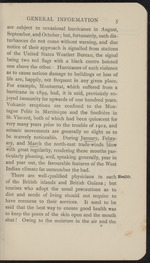 |
“..., rendering these months par-
ticularly pleasing, and, speaking generally, year in
and year out, the favourable features of the West
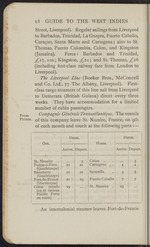
Indian climate far outnumber the bad.
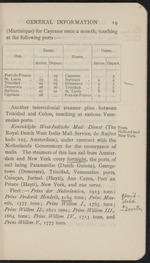
There are well-qualified physicians in each Health,
of the British islands and British Guiana; but
tourists who adopt the usual precautions as to
diet and mode of living should not require to
have recourse to their services. It used to be
said that the best way to ensure good health was
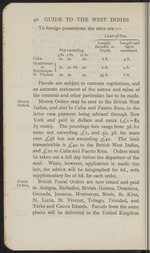
to keep the pores of the skin open and the mouth
shut! Owing to the moisture in the air and the...”
|
|
| 2 |
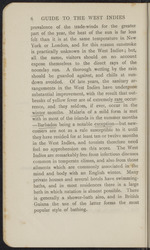 |
“...6 GUIDE TO THE WEST INDIES
prevalence of the trade-winds for the greater
part of the year, the heat of the sun is far less
felt than it is at the same temperature in New
York or London, and for this reason sunstroke
is practically unknown in the West Indies; but,
all the same, visitors should on no account
expose themselves to the direct rays of the
noonday sun. A thorough wetting by the rain
should be guarded against, and chills at sun-
down avoided. Of late years, the sanitary ar-
rangements in the West Indies have undergone
substantial improvement, with the result that out-
breaks of yellow fever are of extremely rare_ occur-
rence, and they seldom, if ever, occur in the
winter months. Malaria of a mild form is met
within most of the islands in the summer months
—Barbados being a notable exception—but new-
comers are not as a rule susceptible to it until
they have resided for at least ten or twelve months
in the West Indies, and tourists therefore need
feel no...”
|
|
| 3 |
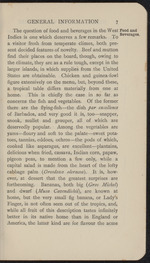 |
“..., cassava, Indian corn, papaw,
pigeon peas, to mention a few only, while a
capital salad is made from the heart of the lofty
cabbage palm (Oreodoxa oleracea). It is, how-
ever, at dessert that the greatest surprises are
forthcoming. Bananas, both big (Gros Michel)
and dwarf (Musa Cavendishii), are known at
home, but the very small fig banana, or Lady’s
Finger, is not often seen out of the tropics, and,
while all fruit of this description tastes infinitely
better in its native home than in England or
America, the latter kind are for flavour the acme...”
|
|
| 4 |
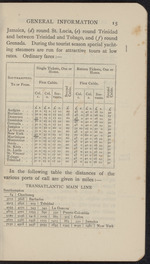 |
“...GENERAL INFORMATION 15
Jamaica, (d) round St. Lucia, (e) round Trinidad
and between Trinidad and Tobago, and (ƒ) round
Grenada. During the tourist season special yacht-
ing steamers are run for attractive tours at low
rates. Ordinary fares :—
Single Tickets, Out or Home. Return Tickets, Out or Home.
Southampton.
To or From. First Cabin. *2 c* First Cabin. Second Cabin.
Col. X. Col. 2. Ser- vants. Jl Col. X. Col. 2. Ser- vants.
Antigua . . . Barbados . . Demerara . Dominica Grenada . . . Jamaica . La Guayra . New York . . Martinique . Montserrat . Nevis .... St. Kitts . . . St. Lucia . . St. Vincent . . Tobago . Trinidad . . . 'S ■g $ 3 'S 'S 3 'Êfè 3 iS 'g ■sfs
|
|
| 5 |
 |
“...18 GUIDE TO THE WEST INDIES
From
France.
Street, Liverpool). Regular sailings from Liverpool
to Barbados, Trinidad, La Guayra, Puerto Cabello,
Curasao, Santa Marta and Cartagena; also to St.
Thomas, Puerto Colombia, Colon, and Kingston
(Jamaica). Fares: Barbados and Trinidad,
^17,10s.; Kingston, ^20; and St. Thomas, ^16
(including first-class railway fare from London to
Liverpool).
The Liverpool Line (Booker Bros., McConnell
and Co. Ltd., 77 The Albany, Liverpool). First-
class cargo steamers of this line sail from Liverpool
to Demerara (British Guiana) direct every three
weeks. They have accommodation for a limited
number of cabin passengers.
Compagnie Générale Transatlantique. The vessels
of this company leave St. Nazaire, France, on 9th
of each month and touch at the following ports :—
Dates. Dates.
Out. Home.
Arrive. Depart. Arrive. Depart, j
St. Nazaire 9 Colon 3
Pointe-è.-Pitre . 20 21 Cartagena . . 4 4
(Guadeloupe) Basseterre 21 21 Savanilla...”
|
|
| 6 |
 |
“...GENERAL INFORMATION 19
(Martinique) for Cayenne once a month, touching
at the following ports :—
Out. Dates. j Dates.
Arrive. Depart. 1 Arrive. Depart. ]
F ort-de-Fran ce 23 Cayenne 3
St. Lucia 23 23 , I Surinam 4 4 |
Trinidad . 24 24 1 Demerara s 5 1
Demerara 26 26 Trinidad 7 7
Surinam . 27 27 St. Lucia 8 8
Cayenne . 28 ... Fort-de-France 9
Another intercolonial steamer plies between
Trinidad and Colon, touching at various Vene-
zuelan ports.
Koninklijke West-Indische Mail Dienst (The From
Royal Dutch West India Mail Service, de Ruyter Newayorknd
kade 125, Amsterdam), under contract with the
Netherlands Government for the conveyance of
mails. The steamers of this line sail from Amster-
dam and New York every fortnight, the ports of
call being Paramaribo (Dutch Guiana), George-
town (Demerara), Trinidad, Venezuelan ports,
Curasao, Jacmel (Hayti), Aux Cayes, Port au
Prince (Hayti), New York, and vice versa.
Fleet: — Prins der Nederlanden, 1923 tons;
Prins...”
|
|
| 7 |
 |
“... ensure complete comfort, it is
better for the traveller to take his or her own.
A photographic camera should certainly be in- Camera,
eluded among the impedimenta of the tour.
Owing to the remarkable rarity of the atmosphere
excellent results can be obtained with a hand
camera; but to secure the best it is desirable,
except in the case of those who develop their own
negatives, to send back the exposed films in tin
cases sealed with sticking plaster for development
at home, and to arrange for a fresh supply of
films or plates to be sent out to them every...”
|
|
| 8 |
 |
“...GENERAL INFORMATION
3i
are aboard, and the steamer is slipping down
Southampton Water, passing Netley on the left,
or the port side, as it should now be called. On
turning into the Solent, Cowes is seen, and then
in succession Yarmouth, Totlands Bay, Alum Bay,
and the Needles to the left, with Hurst Castle
standing out on a spit of sand to the right.
The pilot is dropped off the Needles, and the
steamer proceeds to Cherbourg, where passengers
are embarked that evening, and thence, under the
present arrangements, to Vigo, whose magnificent Vigo,
bay has been the scene of many naval engage-
ments. The town was assaulted and burnt by the
English under Drake and Norris in 1589; and,
on October 22, 1702, the combined English and
Dutch fleets attacked the French and Spanish
in the port. Several men-of-war and galleons
were taken and many destroyed, and an abund-
ance of plate and other valuable effects fell into
the hands of the conquerors. Vigo was taken
by Lord...”
|
|
| 9 |
 |
“...32 GUIDE TO THE WEST INDIES
The Azores, stormy. Four days out the Azores are passed, and j f
though they are not always visible, the Royal Mail
steamer occasionally stops to pick up coal on
the homeward journey. These Western Islands,
as they are also called, belong to Portugal, a
and are supposed to be the site of the ancient | il
Atlantis. They were discovered in the fifteenth o
century by Van der Berg, of Bruges, and by II
1457 the whole of the islands were discovered, p
and the name Azores given to them from the i
number of goshawks (Port. Afor) found on o
them. From 1580 to 1640 they were subject to t
Spain. The islands must always have a peculiar tl
interest for Englishmen as being the scene of the 1
memorable engagement between the Spanish and h
British fleets on August 30, 1591, when the r
redoubtable deeds of valour were performed by ii
Sir Richard Grenville, whose ship the Revenge 1
engaged eight great Spanish galleons for twelve 1
hours, and was boarded...”
|
|
| 10 |
 |
“...GENERAL INFORMATION
33
“ I have fought for Queen and Faith like a valiant
man and true; . . .
With a joyful spirit I Sir Richard Grenville die.”
After passing the Azores, awnings are put out,
md the first touch of the tropics begins to make
itself felt; cooler garments are donned, and the
officers of the ship appear in white suits. Soon
the Sargasso Sea is entered, and tourists will note, The
probably for the first time, the remarkable Gulf l^8*80
weed, which floats in a vast eddy or central pool
of the Atlantic between the Gulf Stream and the
Equatorial current. It was on entering this sea
that the crew of Columbus’ ship very nearly
mutinied, believing as they did that their vessels
had reached land, and were on the verge of
running on the rocks, though really the ocean
is here fully four miles deep. The origin of this
mass of weed is not known, but it presumably
was once attached to rocks, though it is now
propagated as it floats on the surface. In colour,
it...”
|
|
| 11 |
 |
“... or three dayes
promessing faire,” she proceeded on her way, only
to put in at Plymouth on the following Saturday,
the 26th, “ the windes being contrary,” and com-
pelling them to ride at anchor for “ tenne dayes.”
On the 6th of March, “the winde comeing about
to the North-East,” they “ again hoisted sayle and
stood out to sea. . . . The tenth day it blew hard,
which made a verry rough and hollow sea, which
raked us fore and aft, breakeing sometymes over
our quarter; in which great seas, our shipp’s crew...”
|
|
| 12 |
 |
“...Money
Orders.
Postal
Orders.
40 GUIDE TO THE WEST INDIES
To foreign possessions the rates are
Limit of Size.
Not exceeding Length, Breadth, or Depth. Length and Girth combined.
Cuba. 31b. 7 lb. n lb. 2S. 3s. 4s. 2 ft. 4 ft.
Guadeloupe v
or \ 3s. 3s. 6d. 4s. 2 ft. 4 ft.
Martinique )
St. Ihomas 2S. 3s. 4s. 3ift. 6 ft.
Parcels are subject to customs regulations, and
an accurate statement of the nature and value of
the contents and other particulars has to be made.
Money Orders may be sent to the British West
Indies, and also to Cuba and Puerto Rico, in the
latter case payment being advised through New
York and paid in dollars and cents (;£i=$4
87 cents). The poundage fees range from 3d. for
sums not exceeding jQi, and 5 s. 3d. for sums
over ^38 but not exceeding ^40. The limit
transmissible is £40 to the British West Indies,
and £20 to Cuba and Puerto Rico. Orders must
be taken out a full day before the departure of the
mail. When, however, application is...”
|
|
| 13 |
 |
“...GENERAL INFORMATION
45
years’ residence in the colony, immigrants are
entitled to their return passage on paying one-half
the fare in the case of males and one-third in the
case of females, the balance being paid by the
planter. As a matter of fact, the coolies are so
happy and contented in the West Indies that the
proportion availing themselves of the return pas-
sage is very small, especially since the practice was
initiated of giving the coolies land and other
privileges in lieu of back passage, and many of
those who do return to India soon find their way
back to the West Indies again. The ordinances
contain elaborate provisions for the welfare of the
immigrants, and in the colonies employing coolies
there are Protectors of Immigrants to see that the
law is carried out. Surgeon D. W. D. Comins,
who was sent by the Indian Government to the
West Indies to report on the system, declared
that “ as regards the general arrangements made
for Indian immigrants, I have...”
|
|
| 14 |
 |
“...46 GUIDE TO THE WEST INDIES
tinued, owing to a difficulty arising with the
Chinese Government with regard to repatriation.
There still, however, remain many Chinese, who
are closely connected with the retail trade in the
colony.
With regard to the white population, the brief
histories of the various colonies which are given
on subsequent pages will sufficiently indicate their
origin. In the days of slavery each slave owner
was compelled to employ a certain number of
white servants to serve in the militia, and these
men helped to swell the population, while
Oliver Cromwell sent out many Irish prisoners,
I notably to Nevis and Montserrat; and Barbados
1 received a large influx of Royalists at the time
of the Commonwealth. Many English gentle-
men, Royalist officers and divines, were sent out
to the island and sold as slaves, and it is on
record that a number changed hands at a cost of
1500 lbs. of sugar per man! Their descendants,
known as “mean whites,” are still...”
|
|
| 15 |
 |
“...Free-
masonry.
48 GUIDE TO THE WEST INDIES
St. Kitts, while in Montserrat and Dominica
the inhabitants are principally Roman Catholics,
whose bishop resides at Roseau, in the latter
island. The inhabitants of the Virgin Islands
are mainly Wesleyans. In St. Lucia the Roman
Catholics largely predominate, and their church
is supported out of the general revenue of the
colony. In St. Vincent, where the Church of
England was disendowed in 1889, one-half of the
population are members of the Church of Eng-
land and one-third Wesleyans, while in Grenada
one-half are Roman Catholics and one-third
members of the now disestablished Church of
England. In Trinidad the Roman Catholics
are by far the most numerous sect. The Arch-
bishop of Port of Spain resides in Trinidad.
The hours of holy worship differ in no way
from those adopted at home. The churches
are well ventilated, and compare favourably in
this respect with many in European cities.
Freemasonry is largely practised...”
|
|
| 16 |
 |
“...GENERAL INFORMATION 51
by the wealthier classes, and of course a know-
ledge of these languages enhances the pleasure
of a visit to Venezuela.
Jane Anne Smith, the buxom black laundress The
who used to salute passengers on their arrival at Laundry'
Barbados, taking from them their “ washing ” and
selling to them her famous Barbados hot sauce is
—alas!—no more; but she has many imitators.
Some are good and others exceedingly bad. It
behoves tourists therefore to make the closest in- I
quiries before submitting their garments to them.
In most of the islands the laundry work is good,
and the hotels are in touch with the best artistes.
In British Guiana the Chinese undertake washing 1
with the usual satisfactory results. They are past
masters in the art of cleansing clothes.
BOOKS ON THE WEST INDIES
Many books have been written about the West
Indies; but most of the older and standard works
are now, unfortunately, out of print. The follow-
ing list includes the...”
|
|
| 17 |
 |
“...5 6 GUIDE TO THE WEST INDIES
Puerto Rico.
Puerto Rico. By W. Dinwiddie. London:
1899.
Report on the Island of Puerto Rico, its
Population, &c. By H. K. Carroll. Washington:
1899.
Hayti.
Hayti, or the Black Republic. By Spencer St.
John. (2nd edition.) London: 1889.
Where Black Rules White. By Hesketh
Pritchard. London: 1900.
Martinique.
Two Years in the French West Indies. By
Lafcadio Hearn. New York and London:
Harper & Brothers, 1902.
M. Pelée and the Tragedy of Martinique. By
A. Heilprin. London, 1902.
[Any of the above hooks not “ out of print" can be obtained
from Mr. Edward Stanford, 12, 13, and 14 Long Acre,
London, W. C. ]...”
|
|
| 18 |
 |
“...6o GUIDE TO THE WEST INDIES
gets the full benefit of the north-east trade-winds,
and in the winter months the minimum mean
temperature at night falls as low as 63° Fahr.
The annual rainfall varies from about 50 to 70
inches. On the windward side, the climate is
especially invigorating, and the island is much
patronised by residents in neighbouring colonies
as a health resort. The death rate is not more
than 20 per thousand.
History. The actual date of the discovery of Barbados is
uncertain, but it is said that it was visited by
some Portuguese in 1536, who called the island
Los Barbudos after the bearded fig-trees which
/ they found there, and left behind them a stock of
pigs. It was not until 1605 that the British took
possession of the island. In that year the crew of
a vessel called the Olive Blossom, fitted out by Sir
Olave Leigh with stores and settlers for Guiana,
landed on the leeward coast and erected a cross,
inscribing on a tree near by, “ James K. of E...”
|
|
| 19 |
 |
“...BARBADOS
61
reached Barbados in 1626 with about forty emi-
grants, who went ashore and founded Jamestown
or Holetown, near the spot where the first landing
was made. Though authorities have hitherto given
the end of 1624 or the beginning of 1625 as the
date of the arrival of the party, a search of the
island records has made it sufficiently clear that
1626 is actually the year from which the settle-
ment of Barbados dates.
On 13th September 1625, the island was included
in the commission given to Warner, the coloniser
of St. Kitts, his patron being the Earl of Carlisle,
who, two years later, obtained from Charles the
First a grant of nearly all the Caribbean Islands.
The Earl of Marlborough opposed it vigorously;
but the matter was compromised by Lord Carlisle
agreeing to settle on him and his heirs an annuity
of ^300. All went well for a year, and then,
Lord Carlisle being absent on a mission, Sir
William Courteen induced the Earl of Pembroke
to lay claim to the...”
|
|
| 20 |
 |
“...BARBADOS
U
Like this fresh cleansing wave still useful be,
Though rough thy passage to the boundless sea ;
Still in that sea thou shalt not stagnant lie,
But ever useful tasks of blessing ply.”
And on the reverse side of the beams :—
“ Of sacred scenes these crystal streams may tell,
Bethesda’s pool or soft Siloam’s well;
Enjoy the pleasures these pure waters give,
But think of those which make the bathers live.
There is a fountain, Holy Scriptures say,
Where souls may bathe and sins be washed away;
Let all thy studies help thee Him to know
Through whom for thee those heavenly waters
flow.”
St. John’s Church (14 miles, 1J hours by carriage St. John’s
from Bridgetown) stands at a short distance from
the edge of a cliff 824 feet high, which commands
an extensive view of the coral-fringed Windward
Coast. In the churchyard is pointed out the tomb
of Ferdinando Paleologus, the last descendant of
the Greek Christian Emperors of that name, who
were driven from...”
|
|